How the Global Fraud Index Is Calculated
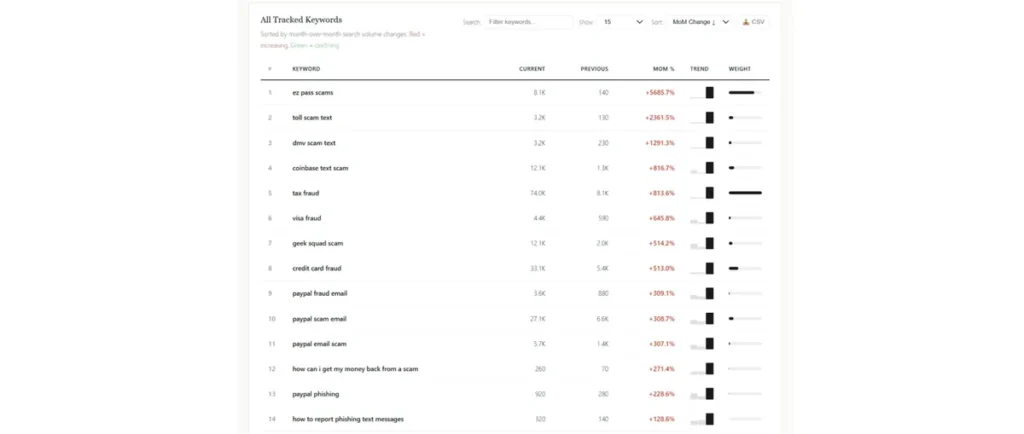
In the modern digital economy, fraud is not merely a legal or financial issue; it is a high-velocity, evolving phenomenon that moves faster than traditional reporting can track. By the time a specific scam—such as a new “toll text” or “AI voice clone” scheme—makes the evening news, the wave has often already crested, leaving millions of victims in its wake.
Enter Civoryx, the creator of the Global Fraud Index. Civoryx was built to solve a specific problem: the information lag in the fraud industry. By shifting the focus from lagging indicators (actual fraud reports, which can take months to verify) to leading indicators (real-time consumer search behavior), Civoryx provides a transparent, data-driven lens into the world of digital deception.
The core of this transparency is the Scam Trend Score. Below, we break down the rigorous methodology, the technical architecture, and the philosophy behind how this index is calculated.
The Philosophy of Civoryx: Data Over Speculation
The Global Fraud Index operates on a simple but powerful premise: No opinions. No speculation. Just data.
Most fraud reports rely on qualitative assessments from security firms or self-reported data from victims. While valuable, these sources are often biased by a firm’s specific client base or by the social stigma that prevents many victims from reporting crimes. Civoryx looks instead at what the world is asking the internet. When people encounter something suspicious—a strange text from the “DMV,” a “Geek Squad” invoice, or a “Zelle” request—they turn to search engines.
By monitoring these queries, Civoryx tracks how fraud attention shifts across the internet in real-time.
The Three-Layer Methodology
The calculation of the Scam Trend Score is a three-layer process designed to distill millions of data points into a single, actionable signal.
1. The Monitor Layer: A Curated Index
Civoryx continuously monitors a curated index of over 150 fraud-related keywords. This isn’t a random collection of terms; it is a strategic map of the fraud landscape covering:
- Phishing & Digital Communication: Terms like “phishing link,” “PayPal scam email,” and “WhatsApp scams.”
- Financial & Banking Fraud: Keywords including “Zelle scams,” “Credit card fraud,” “Bank of America fraud,” and “Wire fraud.”
- Identity & Government Impersonation: Terms such as “Tax fraud,” “Social Security scam,” “DMV scam text,” and “Medicare fraud.”
- Emerging Tech: “Crypto scams,” “Coinbase text scam,” and “Bitcoin fraud.”
2. The Measure Layer: Velocity and Weighting
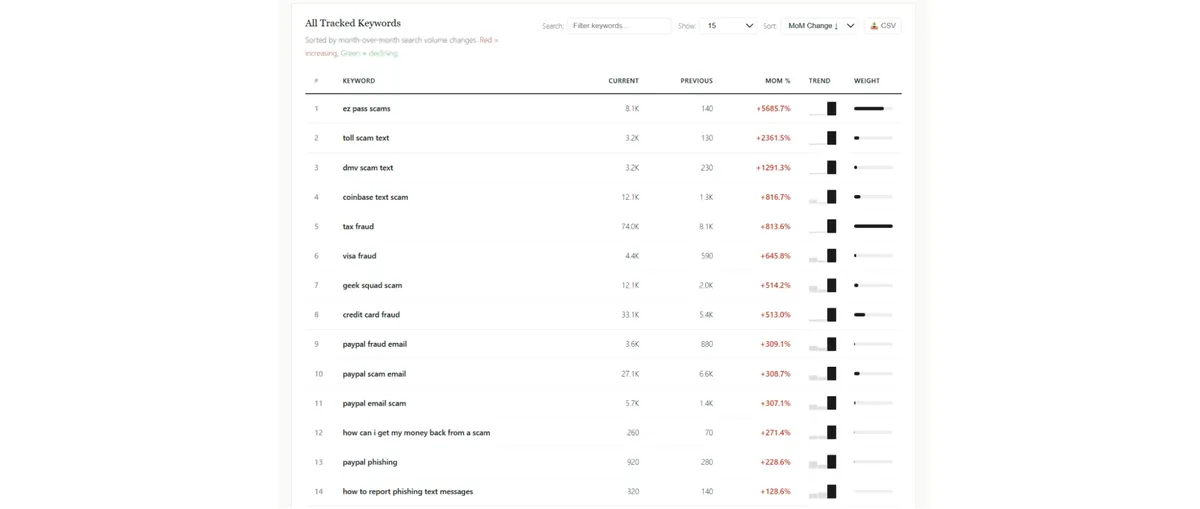
Raw search volume can be misleading. A massive term like “scam” will always have more volume than “EZ Pass scam,” but the latter might be spiking by 500% due to a new localized campaign.
To account for this, Civoryx calculates the Month-over-Month (MoM) change for each keyword. This measures the velocity of interest. To ensure that high-volume terms provide a strong signal without completely drowning out niche (but dangerous) emerging trends, the index uses a square root weighting system.
3. The Score Layer: Aggregation
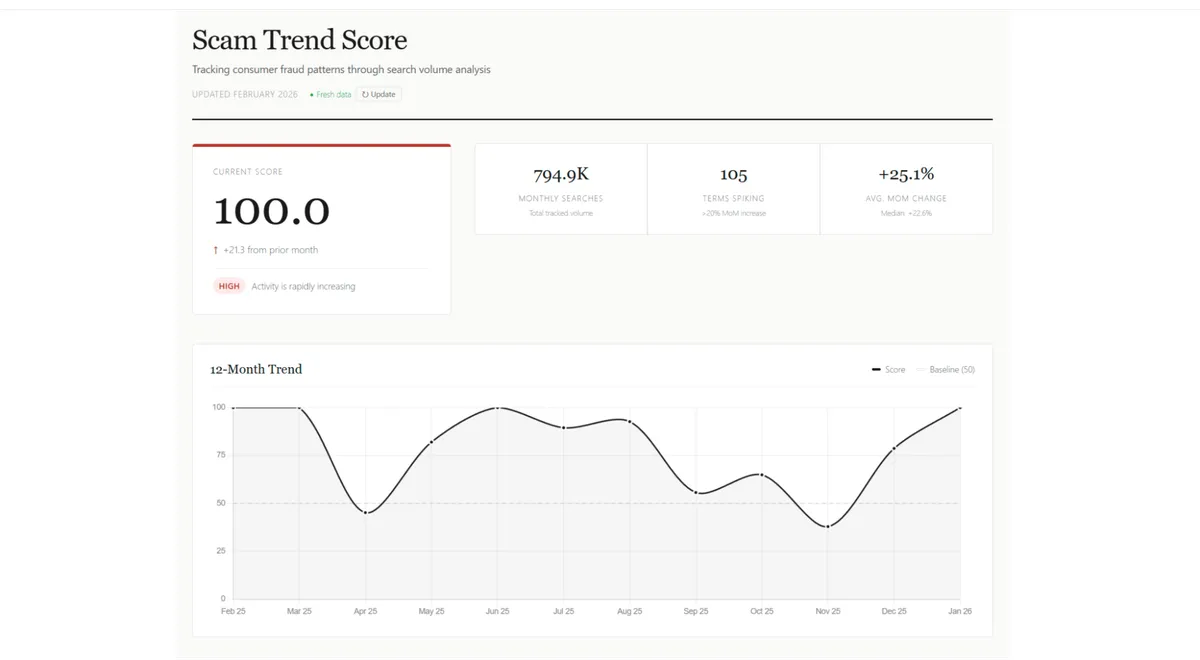
Finally, these weighted changes are aggregated into the Scam Trend Score. This is a composite metric that rises when search interest accelerates and falls when it cools. It provides a “temperature check” for the global fraud environment.
The Technical Formula of Civoryx
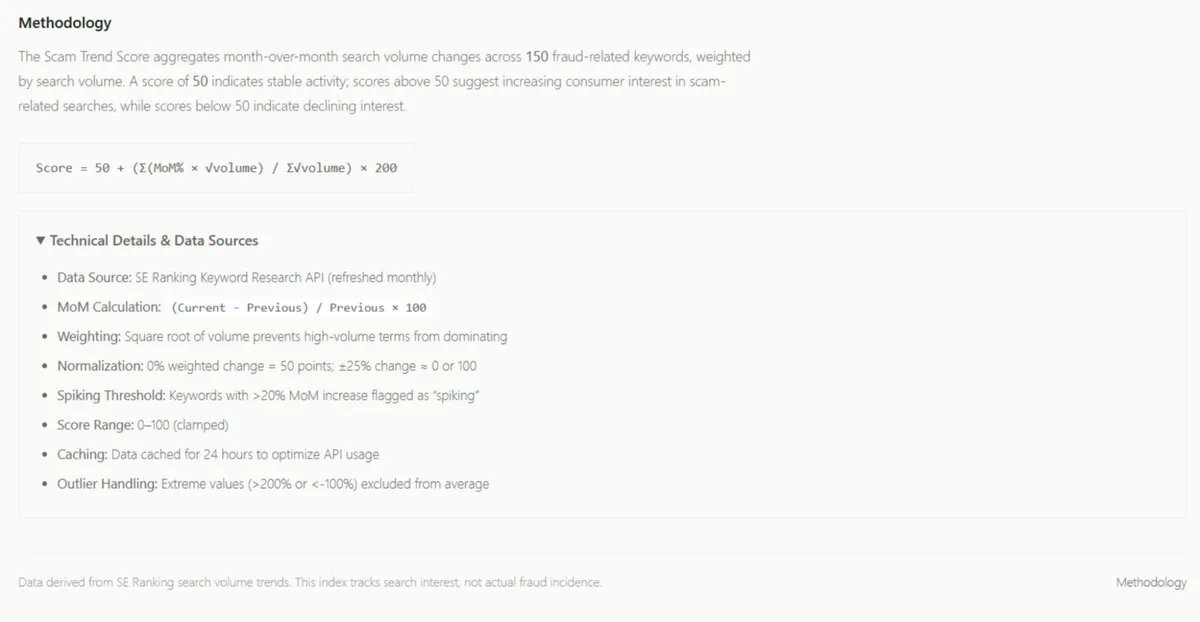
For data scientists, researchers, and cybersecurity professionals, transparency regarding the math is essential. The Scam Trend Score is calculated using the following formula:
Unique Innovation: The Dual-Layer Normalization Model
One of the greatest challenges in tracking search data is seasonality. For example, “Tax fraud” searches naturally spike in April, and “Amazon scams” frequently peak during Black Friday and Cyber Monday. Without correction, these predictable cycles would create “false positives” in the trend score.
To combat this, Civoryx uses a dual-layer normalization model to account for seasonal search fluctuations. This model compares current search spikes not just against the previous month, but against historical baseline averages for that specific time of year. By stripping away predictable seasonal “noise,” Civoryx ensures that a rising score actually represents a new or intensifying threat rather than just a calendar-based trend.
Data Integrity and Handling
To maintain the highest levels of accuracy, Civoryx implements several data-handling protocols:
- Data Source: The index pulls directly from the SE Ranking Keyword Research API, which is refreshed monthly to ensure the latest search behaviors are captured.
- Outlier Handling: Fraud trends can sometimes produce extreme statistical anomalies. To prevent the data from being skewed by “black swan” events or bot-driven search spikes, extreme values (increases of >200% or decreases of <-100%) are excluded from the average.
- Spiking Threshold: Any keyword exhibiting a >20% MoM increase is automatically flagged as “spiking.” This allows the index to highlight specific threats even if the overall Scam Trend Score remains stable.
- Caching: To ensure performance and reliability, data is cached for 24 hours.
Why It Matters: Real-World Applications
The Global Fraud Index isn’t just a statistical exercise; it is a tool for proactive defense.
For Researchers and Journalists
Civoryx serves as an early-warning system. When the index shows a spike in terms like “Poshmark scams” or “Toll scam text,” journalists can investigate and warn the public before the scam reaches a saturation point.
For Compliance and Cybersecurity Teams
Professionals can use the index to align their defensive postures. If “Business Email Compromise” (BEC) related terms are trending upward, IT departments can trigger targeted training for employees.
For Everyday Consumers
The index is a free resource that allows individuals to ask, “Is it just me, or is everyone getting these texts?” By checking the index, users can see if a particular scam is currently “spiking,” providing instant validation and caution.
A Commitment to Open Access
A core tenet of the Civoryx mission is that fraud transparency shouldn’t have a price tag. Because the problem of fraud is universal, the solution must be accessible.
The Global Fraud Index is fully and permanently free. There are no paid tiers, no “premium” data exports, and no gated features:
- Scam Trend Score: Publicly available.
- 150 Keyword Index: Fully transparent.
- No Account Required: Access the data instantly without providing personal information.
By keeping this data open, Civoryx ensures that the collective defense of the internet remains one step ahead of those who seek to exploit it.
Conclusion
The Global Fraud Index represents a shift from reactive to proactive defense. By leveraging the power of search data, applying a rigorous square-root weighting methodology, and utilizing a unique dual-layer normalization model to filter out seasonal noise, Civoryx provides the most accurate reflection of the global fraud landscape available today.
As fraud continues to evolve through AI and social engineering, the Scam Trend Score will remain a vital, transparent, and free signal for anyone looking to navigate the digital world safely.
FAQ
What is the Civoryx Scam Trend Score?
The Scam Trend Score is a composite, data-driven metric that tracks global search interest in fraud and scams. It aggregates the search volume of over 150 specific fraud-related keywords to show whether public concern and potential exposure to scams are rising or falling.
Does a high score mean there is more fraud happening?
Not necessarily. The Index tracks search interest, which is a leading indicator of fraud activity. While search spikes often correlate with active scam campaigns (e.g., people searching “is this DMV text a scam?”), Civoryx measures what people are looking for, not the literal number of confirmed fraud cases reported to authorities.
Why is Civoryx free?
We believe that transparency is the best defense against digital deception. By keeping the Global Fraud Index public and ungated, we provide researchers, journalists, and consumers with a “weather report” for the fraud landscape that isn’t hidden behind a corporate paywall.
Where does the search data come from?
The data is sourced from the SE Ranking Keyword Research API. This provides Civoryx with verified, monthly-refreshed search volume data across major search engines, ensuring their trends are based on actual user behavior.
How often is the Index updated?
The underlying data is refreshed monthly to align with search engine reporting cycles. However, the internal dashboard caches this data for 24 hours to ensure high performance and stability for all public users.
What does a score of 50 represent?
A score of 50 is the baseline. It indicates that fraud-related search interest is stable compared to the previous period. A score of 75 would indicate a significant acceleration in interest, while a score of 25 would suggest a cooling market for those specific scam types.
How does Civoryx handle seasonal spikes like “Tax Fraud” in April?
This is where their dual-layer normalization model comes in. They don’t just look at the month-over-month change. They filter the data through a layer that accounts for historical seasonal fluctuations. This ensures that a predictable seasonal increase doesn’t artificially inflate the Scam Trend Score.
What kind of keywords are included in the index?
They track a curated list of over 150 terms across multiple categories, including:
– Platform-specific: (e.g., “Zelle scams,” “Facebook Marketplace scams”)
– Methodology-based: (e.g., “Phishing email,” “Smishing,” “Brushing scam”)
– Brand impersonation: (e.g., “Geek Squad scam,” “Amazon fraud alert”)
– Action-oriented: (e.g., “How to report a scam,” “Fraud report”)
Why are some extreme values excluded from the score?
To maintain a “clean” signal, we exclude extreme outliers—keywords that jump more than 200% or drop more than 100% in a single month. These are often caused by viral news stories or technical data glitches rather than a sustained shift in the fraud landscape. Excluding them prevents a single “black swan” event from distorting the entire Global Index.
Who should use the Global Fraud Index?
– Cybersecurity Teams: To prioritize employee training based on trending threats.
– Journalists: To identify emerging “spiking” scams for public interest stories.
– Compliance Officers: To monitor the velocity of financial fraud trends.
– Consumers: To verify if a suspicious message they received is part of a broader global trend.
How do I cite Civoryx data?
You are free to use Civoryx data for research, reporting, or internal analysis. You should credit the source as “Civoryx Global Fraud Index.”