How the Global Fraud Index Helps Predict Emerging Scam Threats
Fraud does not spread through press conferences. It spreads through behavior. It moves quietly across digital systems, adapting faster than institutions, regulators, and media cycles can respond. By the time a new scam format becomes widely reported, search interest surrounding it has often already surged, peaked, and started to fragment into variations.
This structural lag creates a visibility gap. Traditional fraud metrics show what has already been documented. They rarely show what is accelerating in real time.
The Civoryx Global Fraud Index was created to address that gap. It transforms decentralized search behavior into a structured macro-level signal that reflects how fraud-related attention shifts globally from month to month.
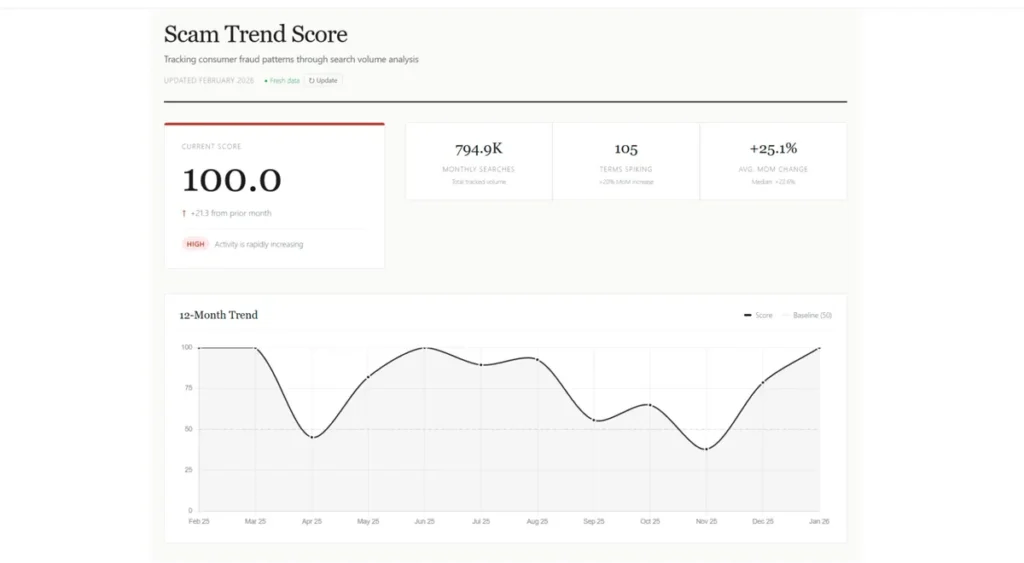
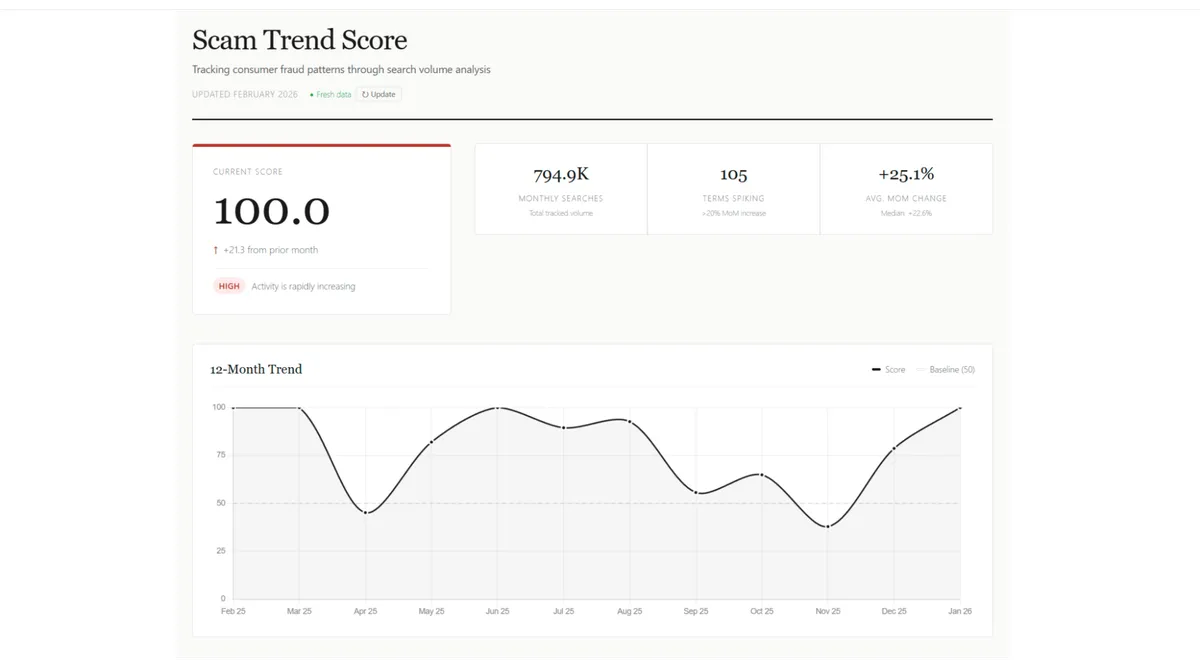
At the center of the system is a single composite metric: the Scam Trend Score.
This guide explains what a Global Fraud Index is, why search data functions as a leading indicator, how Civoryx calculates its score, what makes its dual-layer normalization model unique, how the score should be interpreted, and why open fraud transparency matters.
What Is a Global Fraud Index
A Global Fraud Index is not a crime database. It is not an incident registry. It does not count confirmed losses or prosecutions.
Instead, it measures attention.
Fraud generates financial damage, legal cases, and regulatory responses. But before any of those occur, it generates uncertainty. When individuals encounter something suspicious, they search. They verify. They investigate.
Search engines have become the first global verification layer. Before calling a bank, filing a complaint, or reporting to authorities, people type questions into search bars. Those queries form a behavioral trace.
A Global Fraud Index aggregates those traces into a structured measurement of acceleration. It captures directional movement in fraud-related search activity. It does not measure absolute criminal volume. It measures momentum.
That distinction is critical. Incident reports are lagging indicators. Search velocity is a leading indicator.
Why Search Behavior Reveals Fraud Early
Fraud evolves in compressed cycles. A new tactic appears. Early targets experience it. Suspicion spreads. People search to confirm legitimacy. Media coverage expands. Institutions react.
Search activity appears before institutional stabilization. It reflects real-time exposure and collective doubt.
For example, if a new phishing template begins circulating, recipients may search phrases like “new bank email scam” or “verify account phishing message.” That surge can happen weeks before coordinated reporting emerges.
Search data is decentralized and immediate. It captures exposure at the moment of uncertainty rather than after formal documentation.
Because it measures curiosity and concern rather than confirmation, it often surfaces shifts earlier than official statistics.
Civoryx is built on this behavioral insight.
Introducing Civoryx
Civoryx is the Global Fraud Index. It tracks how fraud attention shifts across the internet.
Its core output is the Scam Trend Score, a composite metric derived from month-over-month search volume changes across more than 150 fraud-related keywords.
Each keyword’s velocity is weighted by its absolute search volume. This produces a single transparent indicator of global fraud-related acceleration or cooling.
No opinions. No speculation. Just data.
Civoryx is fully public and permanently free. There are no paid tiers, no premium dashboards, no gated analytics, and no account requirements.
Fraud affects everyone. Visibility into its movement should be equally accessible.
The Methodology: Three Structural Layers
Civoryx converts raw search data into a structured signal through three core layers: monitoring, measurement, and weighting.
The first layer is monitoring. Civoryx continuously tracks search volume for more than 150 curated fraud-related keywords. These keywords span phishing, identity theft, cryptocurrency scams, romance fraud, impersonation schemes, financial manipulation, account takeover, investment fraud, and social engineering tactics.
The keyword index is intentionally diverse. Fraud rarely operates in isolation. A surge in crypto scams may coincide with impersonation spikes. A rise in phishing may connect to broader identity theft queries. Monitoring across categories captures ecosystem-level movement.
The second layer is measurement. For each keyword, Civoryx calculates the month-over-month percentage change in search volume. Absolute search volume alone does not indicate acceleration. Some terms are consistently popular. What matters is how their momentum changes relative to the prior month.
Month-over-month velocity captures short-cycle dynamics. Fraud tactics can emerge and decline within a quarter. Annual comparisons are too slow to detect early inflection points.
The third layer is weighting. Not every spike carries equal informational value. A low-volume niche keyword doubling in searches may represent limited systemic impact. A modest increase in a high-volume term may signal widespread exposure.
Civoryx weights each keyword’s month-over-month change by its absolute search volume. High-volume signals therefore contribute proportionally more to the composite score.
The weighted changes are aggregated into a single number: the Scam Trend Score.
When the score rises, fraud-related search interest is accelerating globally. When it declines, attention is cooling. When it stabilizes, momentum is steady.
Behind that single metric sits a structured behavioral engine.
The Dual-Layer Normalization Model
Search behavior fluctuates seasonally. Fraud patterns often align with those fluctuations.
Tax-related scams predictably surge during tax season. Retail fraud increases during holiday shopping cycles. Education-related scams rise around admission deadlines. Crypto fraud search interest often mirrors market volatility.
Without proper adjustment, predictable calendar-driven spikes could distort interpretation. A seasonal increase might appear as structural acceleration. A routine decline might appear as systemic improvement.
Civoryx addresses this through a dual-layer normalization model designed specifically to account for seasonal search fluctuations.
The first normalization layer adjusts for historical seasonal baselines. It analyzes recurring annual patterns within each keyword and smooths predictable cycles. This prevents calendar effects from artificially inflating or deflating the composite score.
The second normalization layer evaluates relative systemic movement across the entire keyword ecosystem. If broad macro factors influence search growth across multiple categories simultaneously, this layer prevents generalized expansion or contraction from skewing the index.
Together, these two normalization layers filter predictable seasonal noise while preserving genuine structural acceleration.
This dual-layer normalization model is a defining methodological feature of Civoryx. It enhances signal clarity without suppressing sensitivity.
Why Volume Weighting Matters
Many public trend tools treat all keywords equally. That approach can produce distortion.
If ten low-volume keywords spike dramatically, they may overpower one high-volume category experiencing moderate but globally significant growth.
Volume weighting ensures proportionality. It aligns contribution to real-world scale.
High-volume fraud categories, when accelerating, meaningfully influence the composite score. Low-volume anomalies remain contained.
This preserves interpretability and reduces volatility.
Why Month-Over-Month Analysis Is Critical
Year-over-year analysis is useful for macro trends, but fraud evolves too quickly for annual-only comparisons.
A scam format can appear, proliferate, fragment, and decline within months. Waiting for year-over-year data risks missing early warning signals.
Month-over-month measurement captures inflection points earlier. It identifies acceleration while momentum is forming.
When combined with volume weighting and dual-layer normalization, month-over-month aggregation creates a responsive yet stable index.
It reflects acceleration rather than noise.
Interpreting the Scam Trend Score Responsibly
The Scam Trend Score measures acceleration in fraud-related search activity. It does not directly quantify confirmed fraud losses, criminal arrests, or financial damage.
A sharp increase in the score indicates that global search interest in fraud-related terms is accelerating. This may reflect emerging scam tactics, broader exposure, or heightened awareness.
A declining score suggests cooling momentum. That may indicate stabilization after a surge or decreased exposure within certain categories.
The index should be interpreted directionally. It signals movement in attention, not absolute crime volume.
Search behavior captures suspicion and inquiry. It reflects exposure and uncertainty rather than verified outcomes.
Understanding this boundary ensures accurate and responsible use.
Strategic Applications of Civoryx
Civoryx serves multiple strategic audiences.
Compliance teams can use the index as a macro risk indicator. Rising fraud-related attention may justify enhanced monitoring, internal alerts, or customer education campaigns.
Cybersecurity professionals can treat the score as an external contextual layer. Internal telemetry shows attempted breaches. Search behavior shows public exposure and evolving concern.
Financial institutions can align communication strategies with acceleration phases. If certain fraud categories are gaining search momentum, proactive outreach may reduce vulnerability.
Researchers can analyze the index as a behavioral dataset reflecting collective attention shifts. It offers insight into how fraud narratives cluster and evolve over time.
Journalists can identify emerging themes before saturation. A rising trend in specific categories may signal developing stories.
Consumers can monitor broad ecosystem movement to remain aware of increasing fraud momentum.
Because Civoryx is public and free, access is not limited by budget or organizational scale.
Transparency as a Structural Principle of Civoryx
Composite metrics often become opaque. Civoryx avoids that risk by clearly defining its structure:
- It monitors more than 150 fraud-related keywords.
- It calculates month-over-month percentage change for each term.
- It weights those changes by absolute search volume.
- It applies dual-layer normalization to account for seasonal fluctuations.
- It aggregates the results into a composite metric.
There are no manual editorial overrides. No hidden adjustments. No subjective scoring layers.
The system is systematic and consistent. Transparency strengthens credibility.
What Civoryx Does Not Attempt
Civoryx does not claim to predict specific fraud events. It does not claim to measure total global fraud losses. It does not replace law enforcement statistics.
It measures acceleration in fraud-related search behavior.
Search behavior reflects exposure, suspicion, and verification attempts. It is a behavioral proxy, not a forensic audit.
Recognizing that boundary preserves analytical integrity.
A Real-Time Lens into a Dynamic Threat Landscape
Fraud adapts. Measurement must adapt with it.
The Civoryx Global Fraud Index transforms decentralized search behavior into a structured macro signal. Through continuous keyword monitoring, month-over-month velocity analysis, volume-based weighting, and a dual-layer normalization model designed to account for seasonal search fluctuations, Civoryx delivers a transparent composite metric: the Scam Trend Score:
- It does not rely on opinion.
- It does not depend on speculation.
- It reflects measurable behavioral data.
In a landscape where fraud evolves faster than reporting systems, Civoryx provides a real-time, public lens into how global fraud attention is shifting.
Understanding that movement is not a substitute for enforcement. It is not a substitute for regulation. But it is an early signal. And early signals change outcomes.
Understanding Structural vs. Short-Term Spikes
One of the most important analytical distinctions when interpreting the Scam Trend Score is the difference between structural acceleration and short-term spikes.
Not every increase represents a new fraud wave. Some increases reflect temporary public reaction to media coverage or isolated high-visibility events. When a major news outlet reports on a specific scam format, search interest may surge briefly as readers verify details. That does not always indicate expanding criminal activity.
Structural acceleration looks different. It is sustained across multiple keywords, persists beyond a single news cycle, and often spreads into adjacent fraud categories. For example, a rise in “crypto scam” queries may later expand into searches for “investment fraud recovery” or “how to report digital asset scam.” That pattern suggests ecosystem-level movement rather than momentary curiosity.
Because Civoryx aggregates more than 150 keywords and applies volume weighting, short-lived anomalies tend to dampen naturally unless they represent broader acceleration. The composite structure helps distinguish between reactionary spikes and sustained trend shifts.
Fraud Ecosystems Move in Clusters
Fraud categories rarely evolve independently. Phishing campaigns may precede identity theft searches. Romance scams may connect to financial manipulation or crypto transfer queries. Impersonation schemes may trigger verification searches related to banks, delivery services, or government institutions.
By monitoring across categories simultaneously, Civoryx captures clustering effects. When multiple related keywords accelerate together, the composite score reflects that ecosystem coordination.
This clustering insight is critical. It allows observers to detect not only isolated tactics but broader strategic shifts in fraud methodology.
Conclusion
The Scam Trend Score can be understood as a behavioral risk thermometer. It does not diagnose specific threats, but it reflects temperature change.
When the temperature rises, attention is accelerating. When it cools, momentum stabilizes.
Used consistently over time, the index provides contextual awareness. Organizations can align preparedness, communication, and monitoring intensity with shifts in fraud-related attention.
In dynamic digital environments, context matters as much as detail. Civoryx provides that context in a single transparent metric.
Fraud will continue evolving. The advantage lies in seeing acceleration early.
That is the role of the Global Fraud Index.