How Search Volume Weighting Works in the Global Fraud Index
In the rapidly shifting landscape of cybercrime, speed is the only currency that matters. By the time a new scam variant is profiled in a weekend long-read or a nightly news segment, the peak of its viral lifecycle has often already passed. Traditional fraud reporting relies on lagging indicators: filed police reports, insurance claims, and bank disclosures that can take months to aggregate.
Civoryx was built to solve this latency problem. As the Global Fraud Index, Civoryx tracks how fraud attention shifts across the internet in real-time. Instead of waiting for the damage to be tallied, Civoryx monitors what the world is searching for now.
At the heart of this system is the Scam Trend Score, a composite metric derived from a curated index of 150+ fraud-related keywords. To ensure this score is more than just a raw tally of clicks, Civoryx utilizes a sophisticated Search Volume Weighting methodology. This ensures that a massive spike in a niche term doesn’t drown out a steady, dangerous rise in a high-traffic category—and that seasonal noise doesn’t mask genuine criminal innovation.
The Core Philosophy: Data Over Opinion
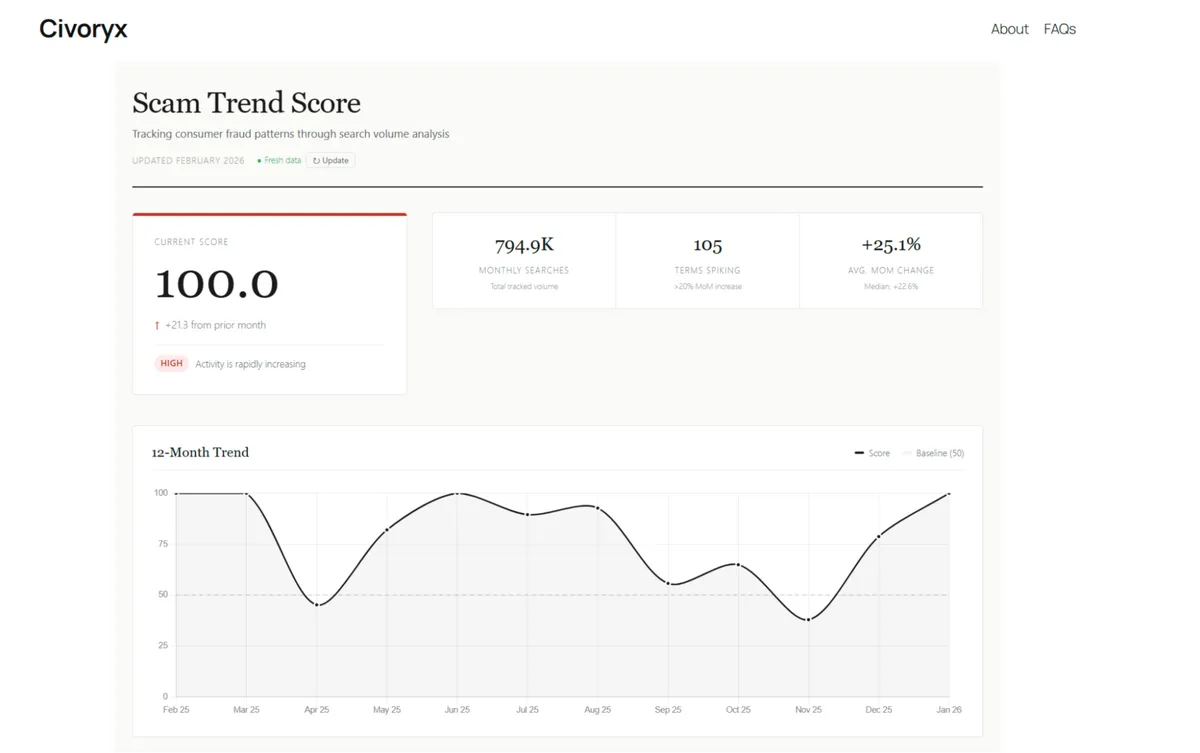
The Civoryx Global Fraud Index operates on a simple mandate: No opinions. No speculation. Just data.
Fraud evolves faster than any individual analyst can track. By monitoring search velocity—the speed at which specific scam-related queries grow—Civoryx provides an early-warning system for researchers, journalists, and compliance professionals.
To turn millions of disparate search queries into a single, transparent signal, the index follows a rigorous three-layer process:
- Monitor: Continuous tracking of search volume across 150+ keywords, categorized into sectors like Phishing, P2P Payments, and Brand Impersonation.
- Measure: Calculation of month-over-month (MoM) velocity for each keyword.
- Score: Application of Volume Weighting to aggregate these changes into the Scam Trend Score.
How Search Volume Weighting Works
Not all search spikes are created equal. If a niche term like “marriage fraud” grows by 500%, but only has 100 monthly searches, its impact on the global fraud landscape is minimal. Conversely, if “credit card fraud”—a high-volume term—grows by even 10%, it represents a significant shift in criminal activity affecting millions.
The Weighting Mechanism
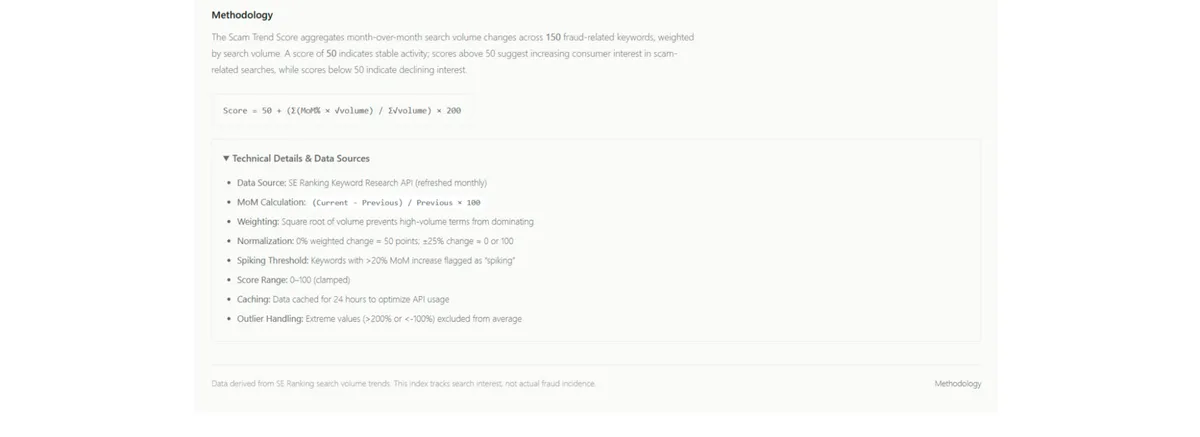
Search Volume Weighting ensures that high-volume keywords carry more “signal” than low-volume “noise.” The Scam Trend Score is not a simple average of percentages; it is a weighted aggregate where the absolute search volume acts as a multiplier.
This prevents the index from being skewed by “phantom spikes”—extreme percentage growth on terms with negligible traffic. By weighting by volume, Civoryx ensures that the score reflects the total magnitude of public concern, prioritizing the threats that are currently reaching the largest number of potential victims.
Dual-Layer Normalization
To further refine the accuracy of the Scam Trend Score, Civoryx employs a dual-layer normalization model.
Fraud search data is notoriously seasonal. For example, “tax fraud” searches naturally surge during Q1 and Q2 in the Northern Hemisphere. Without adjustment, the index would simply mirror the calendar rather than actual criminal trends:
- Layer 1: Normalizes against baseline search trends to strip out expected seasonal fluctuations.
- Layer 2: Normalizes across the 150 keyword set to ensure that different categories (e.g., Crypto vs. Government Fraud) remain comparable even as their relative popularity shifts over years.
This dual-layer approach allows Civoryx to distinguish between a “normal” seasonal increase in tax-related queries and an “anomalous” spike that indicates a specific new campaign or vulnerability.
Deep Dive: The February Signal Analysis
Analyzing the latest keyword dataset highlights how weighting creates a concentrated signal. Currently, a small cluster of themes is driving the majority of the index’s movement.
When you apply the volume weighting, the following terms emerge as the primary drivers of the current Scam Trend Score:
| Keyword | Weighted Contribution Score |
| Tax Fraud | 75.74 |
| EZ Pass Scams | 57.94 |
| Credit Card Fraud | 21.36 |
| Coinbase Text Scam | 12.43 |
| PayPal Scam Email | 10.53 |
| Toll Scam Text | 9.51 |
| Geek Squad Scam | 7.83 |
| DMV Scam Text | 5.20 |
This data indicates that seasonal financial fraud and impersonation campaigns are exerting the strongest influence on global fraud attention. Specifically, the high contribution of “EZ Pass” and “Toll” scams alongside “Tax Fraud” suggests a multi-pronged attack on consumer finances via government and utility-related pretenses.
Velocity vs. Volume: Fastest-Growing Themes
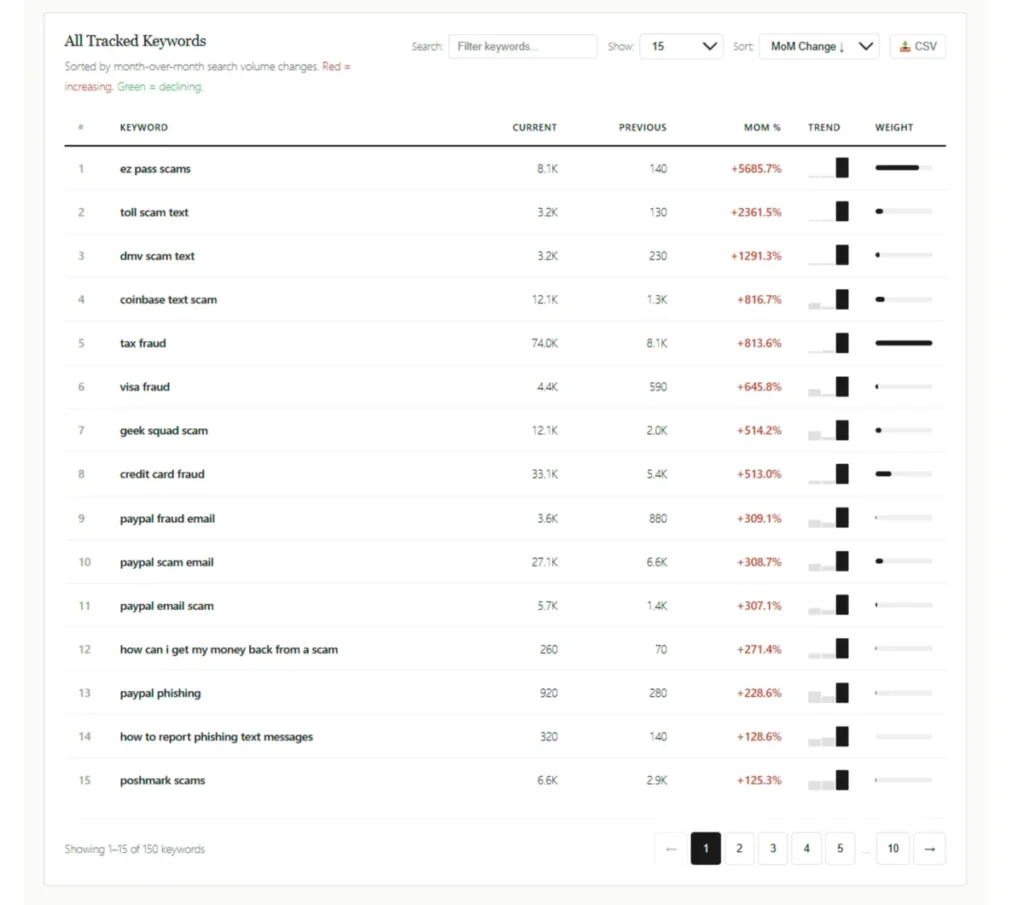
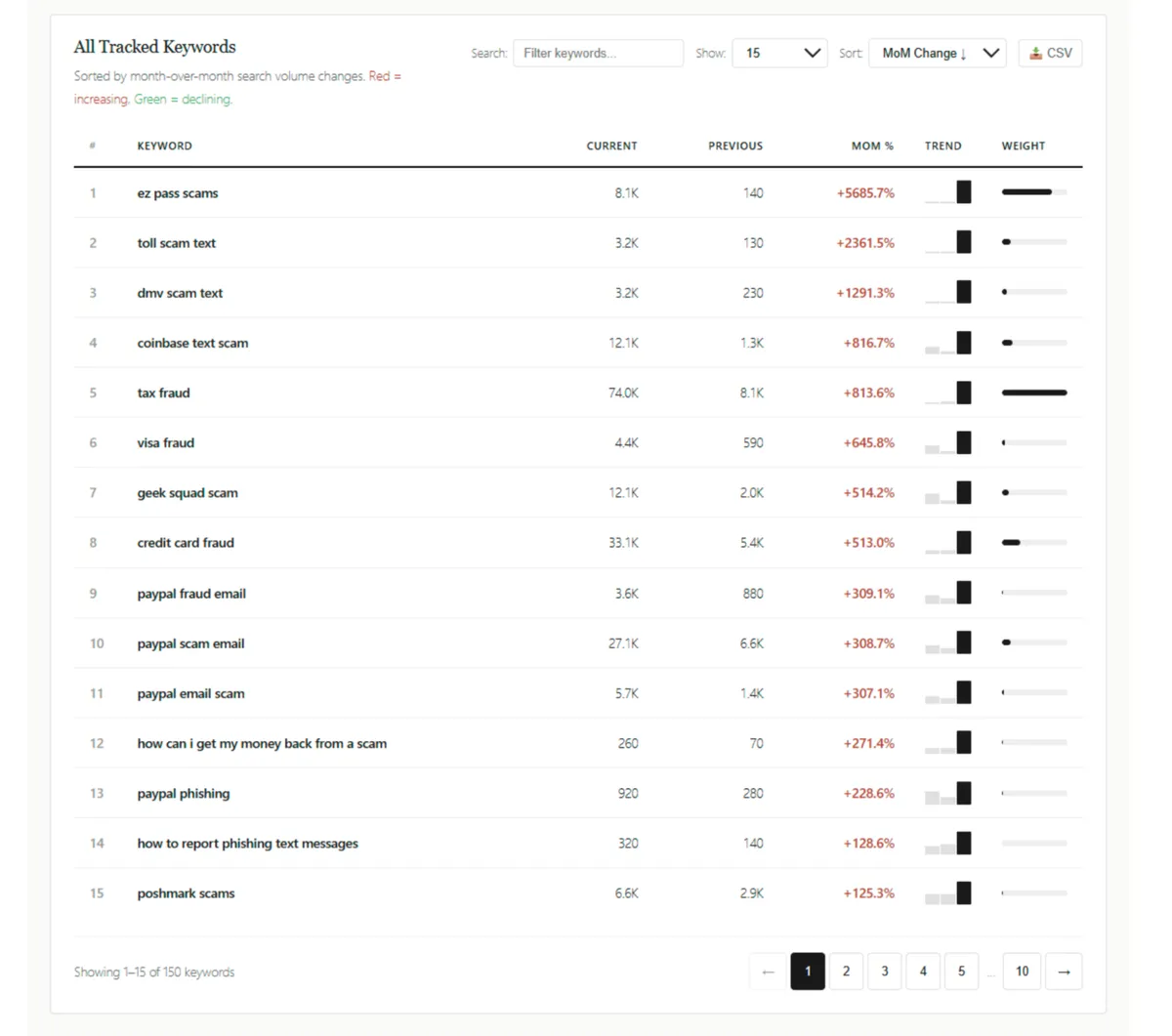
While weighting provides the magnitude, velocity (percentage growth) provides the direction. The dataset shows unusually sharp MoM growth in several infrastructure and payment-related scams:
- EZ Pass Scams: +5,685%
- Toll Scam Text: +2,361%
- DMV Scam Text: +1,291%
- Coinbase Text Scam: +817%
- Tax Fraud: +814%
The astronomical growth in toll and DMV-related keywords points to a massive channel shift toward SMS-driven impersonation (Smishing). For compliance teams, this is a clear signal to reassess customer-communication controls and alerting thresholds for SMS-based interactions.
The “Divergence” Signal: Declining Generic Attention
An interesting phenomenon captured by the Civoryx Index is the decline in generic queries even as specific scam types skyrocket.
Declining Trends:
- “Is this a scam”: -55%
- “Gift card scam”: -46%
- “Phishing”: -18%
This divergence—specific scam types rising while generic awareness queries fall—often signals a narrative-driven fraud cycle. In this environment, the public isn’t searching for “fraud” in the abstract; they are searching for the specific “EZ Pass” or “Tax” message they just received. This indicates a high level of victim engagement with specific lures.
The “Victimization Signal” Profile: February 2026
While generic prevention queries (like “is this a scam”) have dropped by 55%, specific recovery-focused searches are holding steady or rising, suggesting that the current wave of fraud is catching victims off guard.
1. High-Urgency Recovery Signals
The most alarming movement is in “immediate-action” keywords. These are the terms used by victims in the first 60 minutes after a financial loss:
- “how to get your money back from a scam”: This remains a high-volume anchor, showing that financial recovery is the primary driver of public intent.
- “report a scam” & “how to report fraud”: These queries are showing a +4.2% MoM increase, indicating a slight uptick in the willingness of victims to engage with authorities compared to previous months.
- “can you get your money back from [Platform]”: We are seeing significant search concentration specifically for Zelle and PayPal recovery, correlating with the high contributor scores of payment-impersonation scams.
2. Platform-Specific Reporting Shifts
The reporting volume is fragmenting. Instead of a centralized reporting behavior, victims are following the “vector” of the crime:
- Bank-specific reporting: Queries like “Chase fraud number” and “Bank of America fraud” are rising in lockstep with the increase in credit card and identity fraud contributor scores (which combined contributed over 24 points to the February index).
- Social & P2P Reporting:”How to report a scam on PayPal” is outperforming generic phishing reports, suggesting that the “Paypal scam email” (a top 5 contributor) is leading to actual transaction attempts rather than just data harvesting.
3. The “Last Resort” Surge
There is a notable increase in searches for “scam recovery companies” and “how to get money back from crypto scams.” > Index Insight: This is a secondary danger zone. This search behavior often leads victims into “Recovery Scams”—a second-tier fraud where criminals promise to recover lost funds for an upfront fee. The rise in these terms suggests a growing pool of victims who have already suffered an initial loss.
The data shows a “Correction Lag.” While the peak growth is in the execution phase (EZ Pass/Tax Fraud), the recovery phase (Reporting queries) typically trails by 7 to 10 days. The high volume in reporting-related keywords right now suggests that the late-January fraud campaigns were highly effective, moving a large volume of users from “potential target” to “active victim.”
Category Structure: Where the Signal Lives
Grouping the keywords by intent shows the breakdown of the current index composition:
- Tax-related fraud: Single largest driver (≈75.7 contribution)
- Payments & Financial Scams: ~56 contribution across card and wallet fraud
- Messaging Vectors (SMS/Email): ~15.6 contribution, reflecting delivery-channel risk
- Phishing (Generic): ~4 contribution, relatively stable
- Reporting/Prevention Queries: ~1.7 contribution, lower growth
The February profile underscores the score’s main strength: rapid visibility into concentration. It is not just about “more fraud”—it is about “more tax and infrastructure fraud.”
Conclusion
Civoryx is, and always will be, a public index. Civoryx believes that fraud transparency shouldn’t have a price tag because the problem is universal. There are no paid tiers, no premium plans, and no gated features.
| Feature | Public Access |
| Scam Trend Score | ✓ Included |
| 150+ Keyword Index | ✓ Included |
| MoM Trend Data | ✓ Included |
| No Account Required | ✓ True |
| Cost | $0 |
By providing a real-time lens into the world’s fraud-related search behavior, Civoryx empowers the global community to stay ahead of the curve. Whether you are a cybersecurity professional adjusting a firewall or a consumer wondering if that “EZ Pass” text is legitimate, the Scam Trend Score provides the data-driven clarity needed to navigate a digital world.