Global Fraud Index: Which Fraud Keywords Are Trending the Fastest?
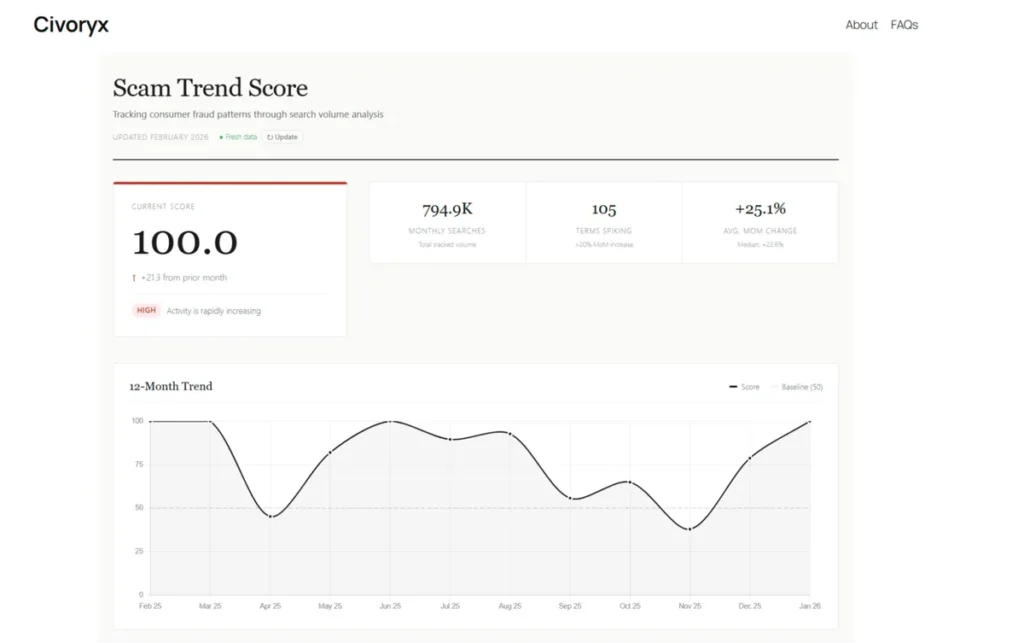
Fraud evolves faster than headlines can follow. By the time a new scam type makes the evening news or trends on social media, its effectiveness has already peaked. Threat actors have moved on, leaving consumers and compliance teams perpetually a step behind.
Civoryx, the Global Fraud Index, was built to change this dynamic. By tracking how fraud attention shifts across the internet, Civoryx surfaces these strategic pivots early. Civoryx provides researchers, journalists, businesses, and everyday users a real-time, data-driven lens into what the world is actively searching for regarding fraud.
No opinions. No speculation. Just data.
Here is a comprehensive breakdown of the fastest-trending fraud keywords, the methodology behind the signal, and what the latest data reveals about the current threat landscape.
The Methodology: How Civoryx Works
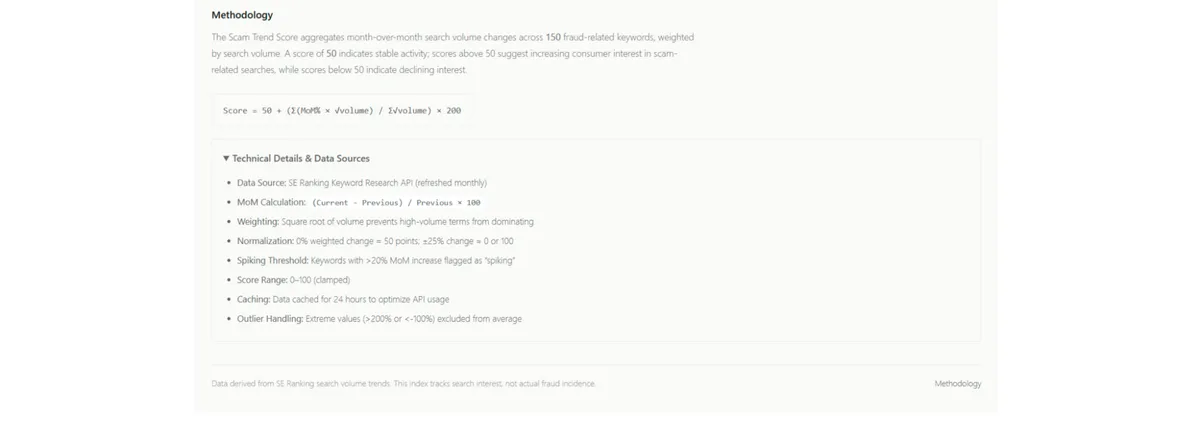
The Civoryx Scam Trend Score aggregates month-over-month search volume changes across 150 meticulously curated fraud-related keywords. By weighting these changes by absolute search volume, the index produces a single, transparent signal indicating exactly where scam activity is trending.
The architecture of the index relies on three distinct layers to produce one definitive score:
- Monitor: Civoryx continuously tracks search volume for over 150 specific fraud-related keywords. This taxonomy spans across multiple threat vectors, including phishing, identity theft, cryptocurrency scams, romance fraud, and brand impersonation.
- Measure: Civoryx calculates the month-over-month (MoM) change for each targeted keyword and weights it by its absolute search volume. This mathematical weighting is critical: high-volume keywords that experience a sudden spike carry significantly more signal than niche, low-volume terms filled with statistical noise.
- Score: The weighted changes are synthesized into a single composite metric known as the Scam Trend Score. A rising score indicates that fraud-related search interest is accelerating on a global scale. A falling score means the landscape is cooling.
To ensure unparalleled accuracy, Civoryx uses a dual-layer normalization model to account for seasonal search fluctuations. Fraud is highly seasonal—tax scams spike in the spring, while retail fraud surges during the holidays. Our dual-layer normalization strips away these predictable annual patterns, isolating genuine, anomalous trend acceleration from routine seasonal noise.
The Current Threat Landscape: Analysis of the Latest Dataset
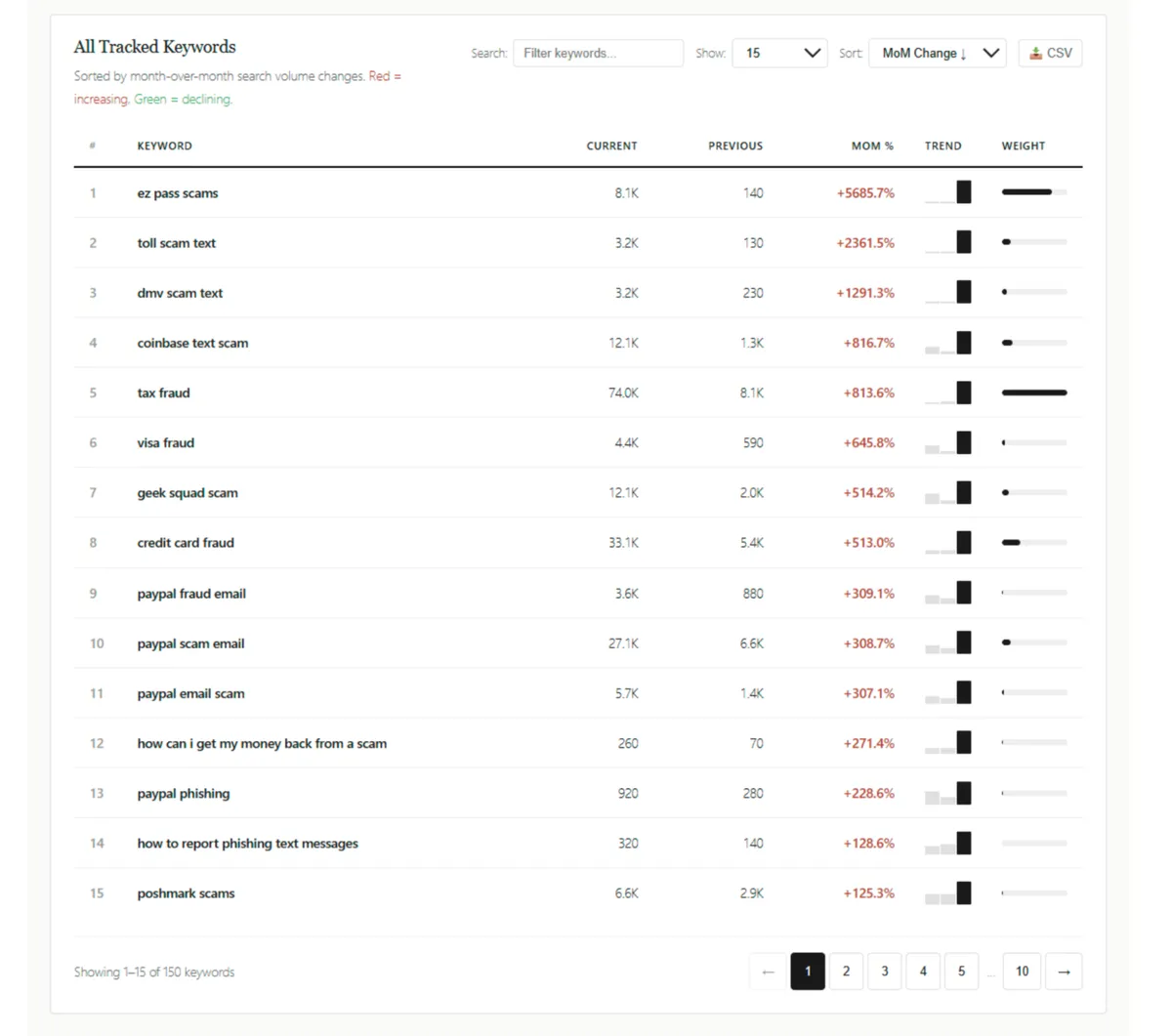
Analysis of the latest keyword dataset highlights a highly concentrated signal. A remarkably small cluster of specific themes is currently driving the vast majority of the index movement.
Top Contributors to the Scam Trend Score
The following keywords had the largest weighted impact on the global index. This concentration clearly indicates that seasonal financial fraud and highly targeted impersonation campaigns are currently exerting the strongest influence on global fraud attention.
| Fraud Keyword | Weighted Contribution Score |
| Tax fraud | 75.74 |
| EZ Pass scams | 57.94 |
| Credit card fraud | 21.36 |
| Coinbase text scam | 12.43 |
| PayPal scam email | 10.53 |
| Toll scam text | 9.51 |
| Geek Squad scam | 7.83 |
| DMV scam text | 5.20 |
| Visa fraud | 3.57 |
| PayPal email scam | 2.20 |
Fastest-Growing Scam Themes
Beyond the weighted contribution, looking purely at velocity reveals explosive growth in specific tactical vectors. The dataset shows unusually sharp month-over-month growth in several infrastructure and payment-related scams.
| Scam Theme | MoM Growth Velocity |
| EZ Pass scams | +5,685% |
| Toll scam text | +2,361% |
| DMV scam text | +1,291% |
| Coinbase text scam | +817% |
| Tax fraud | +814% |
| Visa fraud | +646% |
| Geek Squad scam | +514% |
| Credit card fraud | +513% |
Together, these massive percentage spikes point to a definitive channel shift toward SMS-driven impersonation (smishing) and immediate payment fraud. Scammers are moving away from easily filtered emails and targeting consumers directly on their mobile devices using authoritative public infrastructure (tolls, DMV, taxes). Compliance teams and fraud analysts must use this data to aggressively reassess customer-communication controls and internal alerting thresholds.
Declining Attention: The Narrative Cycle
Not all categories are experiencing upward velocity. Searches for broader, more generic queries fell significantly over the same period:
| Generic Query | MoM Decline |
| Is this a scam | -55% |
| Gift card scam | -46% |
| McAfee scam | -45% |
| Brushing scam | -19% |
| Phishing | -18% |
This stark divergence—where highly specific scam types (like “toll scam text”) are rising rapidly while generic awareness queries (like “is this a scam”) fall—is a classic indicator of a narrative-driven fraud cycle. When specific threats dominate the public consciousness, victims search for the exact parameters of the scam they are experiencing rather than general advice.
The 150-Keyword Index Taxonomy
To understand the full scope of the Civoryx signal, it is necessary to examine the foundational 150 keywords they monitor. These are categorized by the intent and methodology of the threat actors.
1. Phishing & Digital Communication
These terms track the most common initial points of entry for fraudsters—spoofed emails, malicious links, and SMS phishing (“smishing”). When volume in this category spikes, it indicates a massive, untargeted broadcast campaign by threat actors.
Keywords tracked: phishing, phishing email, phishing scam, phishing attack, phishing link, phishing text, email phishing, email scam, report phishing, report phishing email, apple report phishing email, how to report phishing on gmail, how do I report phishing to gmail, where to report phishing emails, where can I report phishing emails, where to forward phishing emails, where do I forward phishing emails, how to stop phishing emails, how can I stop phishing emails, how do you stop phishing emails, how to avoid phishing emails, how to block phishing emails, how to stop phishing scams, how to avoid phishing scams, how to stop phishing attacks, how to prevent phishing emails, what to do if you click on a phishing link, what to do if I clicked on a phishing link, how to report phishing text messages.
2. P2P Payment & Banking Scams
With the global rise of instant, irreversible digital transfers, Peer-to-Peer (P2P) fraud has become a primary focus for criminal networks. These keywords monitor the financial platforms most frequently targeted.
Keywords tracked: zelle scams, venmo scams, venmo scam, cash app scam, cashapp scam, paypal scam, paypal scam email, paypal email scam, paypal fraud, paypal fraud email, paypal phishing, how to report a scam on paypal, chase fraud number, bank of america fraud, capital one fraud, us bank fraud, credit card fraud, visa fraud, how to avoid credit card scams, apple pay scams, bank fraud, fraud alert, how to place a fraud alert on your credit report, how to place fraud alerts on credit reports.
3. Brand & Service Impersonation
Scammers leverage the established trust of global brands to lower their victims’ psychological defenses. These terms track the most common corporate and utility impersonations.
Keywords tracked: amazon scam, can you get scammed on amazon, geek squad scam, mcafee scam, ebay scam, poshmark scams, can you get scammed on airbnb, verizon fraud, publishers clearing house scams, toll scam text, ez pass scams, DMV scam text.
4. Identity & Government Fraud
These keywords track traditional, yet devastating, high-impact crimes involving the theft of government documents, personal identification, and institutional theft.
Keywords tracked: identity fraud, tax fraud, insurance fraud, insurance scam, insurance scams, mail fraud, check fraud, check scam, wire fraud, property fraud alert, marriage fraud, how do i report marriage fraud to immigration, medicare fraud, medicaid fraud, welfare fraud, how to report welfare fraud, how do you report welfare fraud, report food stamp fraud, fraud waste and abuse, fraud waste abuse.
5. Social Engineering & Romance
Focusing entirely on the psychological manipulation of victims, these scams often play out over months and frequently represent the highest devastating financial losses per individual victim.
Keywords tracked: romance scam, whatsapp scams, facebook scam, facebook marketplace scams, whatsapp scam, scam call, scam calls, scam phone number, scam number, how to report a scam number, how to block scam likely calls, how to stop scam callers, how to get scam calls to stop, how to stop receiving scam calls, where to report scam calls, how can i stop scam calls, how do you report scams on craigslist, how do i report a scam to craigslist, how do i report fraud on craigslist.
6. Emerging Threats: Crypto & Modern Scams
As technology and consumer habits evolve, so do the categories within the Civoryx Index. This section monitors modern asset classes and complex technical fraud.
Keywords tracked: crypto scam, bitcoin scams, coinbase text scam, brushing scam, computer fraud and abuse, fraud investigation, fraud detection, fraud report, fraud score, is this a scam, how to spot a scam, how to know if website is a scam, how do i know if a website is a scam, how to tell if a job is a scam.
7. Recovery & Reporting
These keywords act as undeniable “victimization signals.” When search volume in this specific category rises, it is a lagging indicator that a high rate of scams have already been successfully executed, and victims are now actively seeking recourse.
Keywords tracked: fraud, scam, number scam, text scam, text message scam, phone number scam, gift card scam, alert scam, health care fraud, scam alert, scam alerts, how to report a scam, how to report scam, how to report fraud, how to report a company for fraud, how do i report a fraud company, where can you report fraud, report fraud, report a scam, report scam, who do you report scams to, what to do if you ve been scammed, what to do if you have been scammed, what to do if u have been scammed, what to do if u get scammed, what do you do if you have been scammed, how to get your money back from a scam, how to get your money back from scams, how do i get my money back from a scam, how can i get my money back from a scam, how to stop a scam.
Conclusion
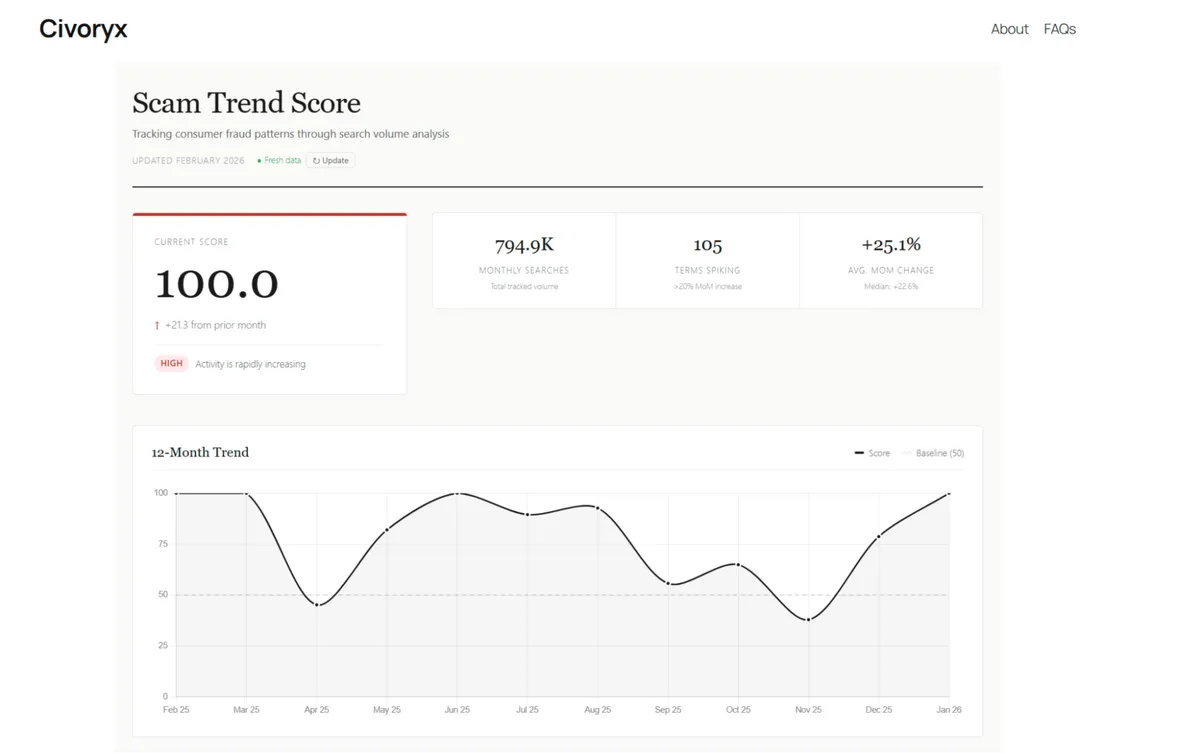
The data surfaced by Civoryx is inherently valuable to financial institutions, cybersecurity firms, and regulatory bodies. However, Civoryx maintains a strict philosophy regarding access.
Civoryx is a public index. There are no paid tiers, no premium plans, and no gated features. Civoryx offers:
- Public Access: Unrestricted.
- Scam Trend Score: Free.
- 150+ keyword index: Free.
- Month-over-month trend data: Free.
- Account Required: No.
- Cost: $0.
Civoryx firmly believes that fraud transparency should not come with a price tag. The data remains open because the problem of digital fraud is universal. By democratizing access to this intelligence, Civoryx empowers both everyday consumers and enterprise compliance teams to see the threats coming before the damage is done.