Global Fraud Index: What Month-Over-Month Search Volume Changes Reveal About Scam Trends
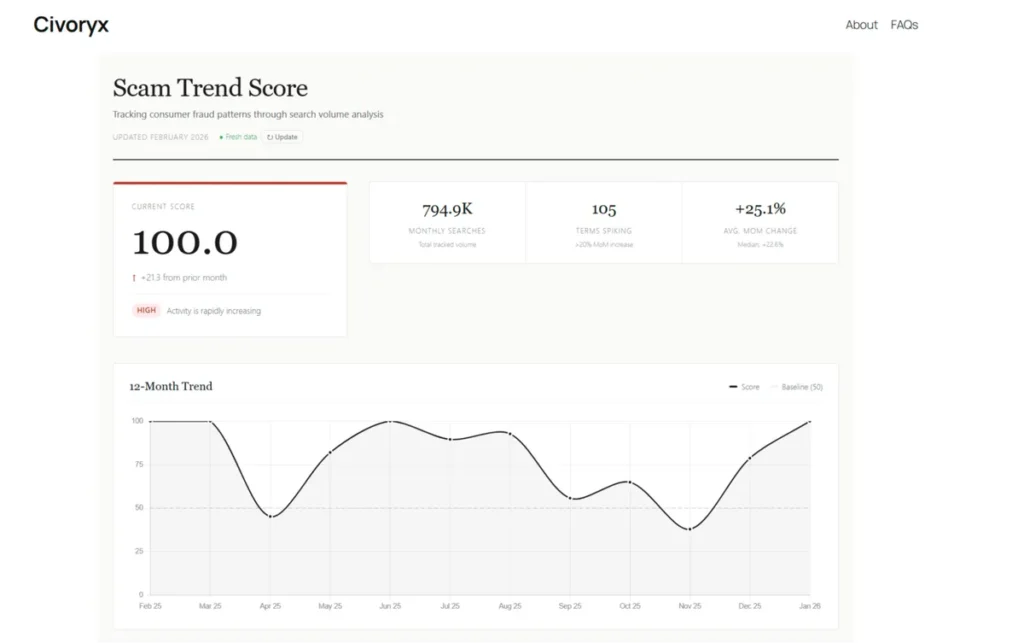
Fraud evolves exponentially faster than the headlines can follow. By the time a new phishing campaign or impersonation tactic makes the evening news, the damage has already been done, and the threat actors have likely pivoted to a new vector. Traditional threat intelligence often relies on lagging indicators—reported financial losses, victim complaints, or post-mortem cybersecurity reports. But what if we could intercept the narrative before the peak?
This is where search volume velocity becomes an invaluable forensic tool. The Civoryx Global Fraud Index was built to surface these shifts early, providing researchers, journalists, businesses, and everyday users with a real-time lens into what the world is searching for when it comes to deception.
This article unpacks the underlying methodology of the Civoryx Scam Trend Score and analyzes the latest dataset to reveal how global fraud attention is currently shifting, what vectors are accelerating, and what compliance teams need to know to stay ahead.
The Philosophy of Civoryx: Speed, Data, and Transparency
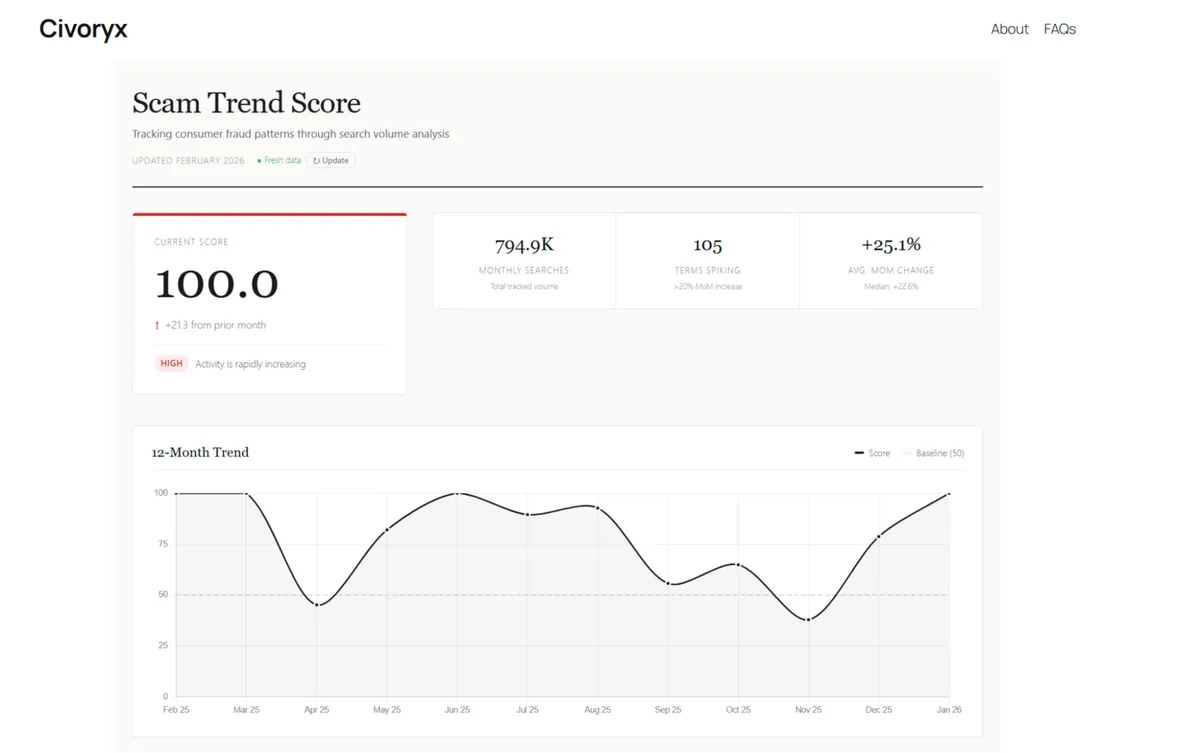
Civoryx exists to solve a fundamental asymmetry in the fight against cybercrime: scammers share tactics instantly, while institutional defenses are often siloed and slow. Civoryx tracks how fraud attention shifts across the internet by monitoring search behavior.
The core ethos is simple: No opinions. No speculation. Just data. It is designed for anyone who needs to understand the fraud landscape, from banking compliance officers adjusting transaction monitoring rules to everyday consumers trying to verify a suspicious text message. Because the problem of fraud is universal, Civoryx operates on a foundational belief that fraud transparency shouldn’t have a price tag.
Pricing and Accessibility:
- Cost: $0 (Free. Fully. Permanently.)
- Features: Access to the 150+ keyword index, month-over-month trend data, and the Scam Trend Score.
- Gating: No account required, no premium plans, no paywalls.
How It Works: The Mechanics of the Scam Trend Score
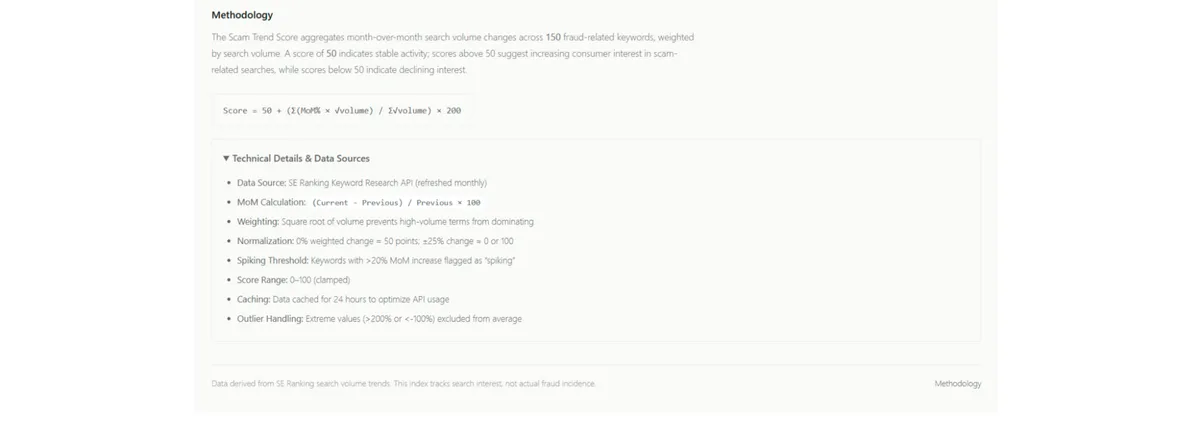
The engine behind the platform is the Scam Trend Score, a composite metric that rises when fraud-related search interest accelerates globally and falls when it cools. It is generated through a rigorous three-layer process:
- Monitor: Civoryx continuously tracks search volume for a highly curated index of over 150 fraud-related keywords. This taxonomy spans diverse categories, including phishing, identity theft, crypto scams, romance fraud, and government impersonation.
- Measure: The system calculates the month-over-month (MoM) change for each keyword. Crucially, these changes are weighted by their absolute search volume. High-volume keywords that experience sudden spikes carry a much stronger signal than niche terms that may exhibit high percentage growth but suffer from low-volume statistical noise.
- Score: These weighted changes are aggregated into a single, transparent composite metric.
The Unique Advantage: Dual-Layer Normalization
Raw search volume can be notoriously misleading. For instance, searches for “tax fraud” naturally spike globally every spring. If a model relies purely on raw month-over-month volume, it will inevitably trigger false alarms driven by the calendar rather than by criminal innovation.
To solve this, Civoryx uses a dual-layer normalization model to account for seasonal search fluctuations.
Layer 1 normalizes the data against baseline historical search volumes to establish standard operational traffic.
Layer 2 applies a seasonal adjustment algorithm that accounts for expected, cyclical calendar events (like tax season or holiday shopping).
Because of this dual-layer normalization, when the Scam Trend Score flags a spike, it indicates an anomalous acceleration beyond standard seasonal interest, providing a much higher-fidelity signal for compliance and intelligence teams.
Data Deep Dive: Top Contributors Driving the Index
An analysis of the latest February dataset highlights a highly concentrated signal. A remarkably small cluster of themes is currently driving the vast majority of index movement.
The table below outlines the top contributors to the overall Scam Trend Score, ranked by their largest weighted impact.
| Rank | Scam Theme / Keyword | Weighted Score Contribution |
| 1 | Tax fraud | 75.74 |
| 2 | EZ Pass scams | 57.94 |
| 3 | Credit card fraud | 21.36 |
| 4 | Coinbase text scam | 12.43 |
| 5 | PayPal scam email | 10.53 |
| 6 | Toll scam text | 9.51 |
| 7 | Geek Squad scam | 7.83 |
| 8 | DMV scam text | 5.20 |
| 9 | Visa fraud | 3.57 |
| 10 | PayPal email scam | 2.20 |
From a strategic compliance perspective, this concentration is highly revealing. It indicates that seasonal financial fraud and highly targeted impersonation campaigns are currently exerting the strongest influence on global fraud attention.
While tax fraud historically holds weight around this time, its massive contribution (75.74) coupled with the sudden dominance of infrastructure impersonation (EZ Pass, DMV, Tolls) suggests that threat actors are aggressively combining seasonal anxieties with immediate, transactional panic to force victim compliance.
The Velocity of Deception: Fastest-Growing Scams
While total volume (weighted impact) tells us what is dominating the landscape, velocity—the month-over-month percentage growth—tells us where threat actors are pivoting. The dataset shows unusually sharp MoM growth in several infrastructure and payment-related scams.
Fastest-Growing Scam Themes (MoM Search Velocity):
- EZ Pass scams: +5,685%
- Toll scam text: +2,361%
- DMV scam text: +1,291%
- Coinbase text scam: +817%
- Tax fraud: +814%
- Visa fraud: +646%
- Geek Squad scam: +514%
- Credit card fraud: +513%
The narrative hidden within these percentages is stark: there is a massive, coordinated channel shift toward SMS-driven impersonation (often called “smishing”).
Threat actors are moving away from easily filtered email campaigns and toward the intimacy and urgency of a text message. By impersonating local infrastructure entities—like regional toll authorities (EZ Pass) or the Department of Motor Vehicles (DMV)—scammers create an immediate sense of localized urgency. A victim might ignore an email about a generic suspended account, but a text message threatening an immediate fine for an unpaid highway toll often bypasses logical defenses.
For enterprise compliance teams, this pattern provides actionable intelligence. It signals an immediate need to reassess customer-communication controls, update alerting thresholds for small-dollar immediate payments, and proactively educate customers on how the institution utilizes SMS.
The Divergence: Why Some Categories Are Declining
Equally as important as what is rising is what is falling. The Civoryx data reveals a fascinating divergence in the ecosystem. Searches for broader, more generic educational queries fell sharply month-over-month:
- Is this a scam: -55%
- Gift card scam: -46%
- McAfee scam: -45%
- Brushing scam: -19%
- Phishing: -18%
This divergence—where specific, hyper-targeted scam types rise astronomically while generic awareness queries plummet—often signals a narrative-driven fraud cycle.
When a few prominent threats dominate public attention (like an epidemic of fake toll texts), consumer search behavior becomes highly specific. Victims aren’t searching for generic terms like “phishing” or asking the internet “is this a scam?” Instead, they are searching for the exact phrasing of the text message they received: “toll scam text” or “EZ Pass scam.”
This drop in generic terms does not mean overall fraud is decreasing; rather, it suggests that current campaigns are highly recognizable by their specific brand impersonations, prompting exact-match search queries.
Category Structure of the Signal
Grouping the keywords by underlying intent shows exactly how the index composition breaks down, providing a clear map of current threat vectors.
The February profile underscores the score’s main strength: rapid visibility into where fraud attention is concentrating right now.
- Tax-related fraud (≈75.7 contribution): The single largest driver of the index. This reflects the intense, high-stakes nature of seasonal tax filing, where fear of government reprisal makes victims highly susceptible.
- Payments & financial scams (~56 contribution): Spanning credit card and digital wallet fraud. This highlights the continuous baseline pressure on payment rails and consumer banking infrastructure.
- Messaging vectors (~15.6 contribution): Encompassing SMS, email, and phone call queries. This category accurately reflects the delivery-channel risk, emphasizing the explosive growth of text-based deception.
- Phishing – generic (~4 contribution): Remaining relatively stable but overshadowed by specific branded attacks.
- Reporting/prevention queries (~1.7 contribution): Lower growth, suggesting that consumers are currently in a reactive state (identifying immediate threats) rather than a proactive state (seeking generalized prevention education).
Conclusion: Adapting to the Velocity of Fraud
The data from the Civoryx Global Fraud Index paints a vivid picture of a rapidly adapting criminal ecosystem. We are witnessing a distinct pivot toward mobile-first, infrastructure-impersonation attacks that leverage urgency and localized authority.
By analyzing the month-over-month search volume changes, organizations can transition from a reactive defensive posture to a proactive one. When a massive spike of +5,685% in “EZ Pass scams” is detected through search velocity, financial institutions, telecommunications providers, and consumer advocacy groups have a critical window to deploy countermeasures before the lag-time of traditional reporting catches up.
Information parity is the first step in dismantling fraud networks. By making this data public, weighted, and dual-layer normalized against seasonal noise, the Civoryx Scam Trend Score provides the exact coordinates of where cybercriminals are operating today.