Global Fraud Index vs. Other Fraud Indicators: Why Search Trend Data Matters
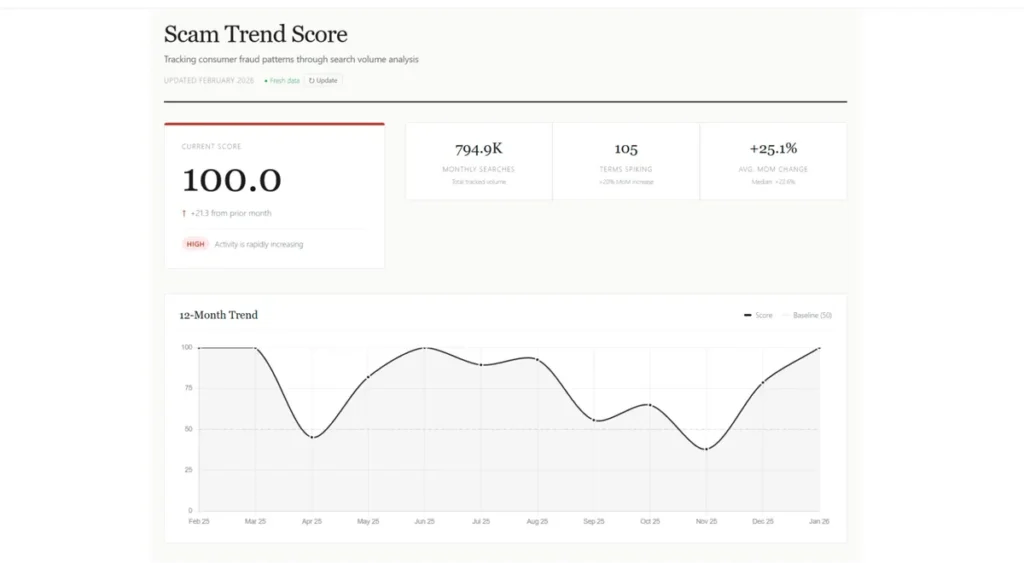
In the world of cybersecurity, the most dangerous threat is the one you don’t see coming. For years, the industry has relied on “lagging indicators”—historical reports, bank statements, and post-incident analyses—to map the fraud landscape. But by the time a new scam reaches a formal report, the damage is already done.
Enter Civoryx, the Global Fraud Index. By shifting the focus from historical records to real-time search velocity, Civoryx provides a proactive “weather map” for digital deception.
What Is a Fraud Indicator?
In the simplest terms, a fraud indicator is a red flag or a specific data point that suggests a fraudulent activity might be occurring, has occurred, or is being planned. These indicators act as “breadcrumbs” left behind by illicit actors as they navigate the digital and financial world.
Traditionally, these indicators are categorized into two types:
- Behavioral Indicators: These look at how someone acts—such as a user suddenly logging in from a different country or a customer showing unusual urgency in a wire transfer.
- Transactional Indicators: These look at the data—such as a sudden spike in high-value purchases, “structuring” (breaking large sums into small amounts), or a bank account receiving multiple transfers from unrelated sources.
Civoryx introduces a third, more proactive category: Search-Based Indicators. This measures the collective “noise” of potential victims searching for answers before a crime is even completed.
Why Are Fraud Indicators Important?
Fraud indicators are the backbone of modern security because they provide the context necessary to move from guesswork to precision defense. Their importance can be summarized in three key areas:
1. Reducing the “Mean Time to Detect” (MTTD)
The longer a fraud scheme runs, the more damage it does. Indicators allow systems to flag anomalies in milliseconds. By monitoring Civoryx’s Scam Trend Score, organizations can see a specific type of fraud gaining momentum globally before it even hits their own internal servers.
2. Proactive Risk Mitigation
If indicators show a 40% increase in “AI voice cloning” searches, a bank can proactively send an alert to its customers. Instead of reacting to a loss, indicators allow for preemptive education, stopping the scam at the psychological level before the transaction level.
3. Resource Allocation
No security team has infinite time or money. Indicators help professionals prioritize where to look. By identifying which fraud types are “cooling” and which are “accelerating,” businesses can focus their compliance and engineering efforts on the threats that pose the most immediate risk.
Traditional Indicators vs. Search Data
To understand why search trend data is a game-changer, we must compare it against the established metrics used by financial institutions and regulatory bodies.
1. The Reporting Gap (Official Statistics)
Government and law enforcement agencies (such as the FTC in the U.S. or Action Fraud in the UK) provide invaluable data, but it is inherently delayed. These reports rely on victims realizing they’ve been scammed and filing a formal complaint. This creates a “reporting gap” that can span months, during which fraudsters have already moved on to their next tactic.
2. Transaction Monitoring (Behavioral Patterns)
Financial institutions use Transaction Monitoring to detect suspicious behavior over time. This involves looking for “red flags” like:
- Structuring: Rapid movement of funds across multiple accounts to avoid detection.
- Velocity Spikes: A sudden, uncharacteristic surge in transaction frequency.
- Geographic Deviations: Payments originating from or traveling to high-risk jurisdictions.
While excellent for spotting money laundering, this is a reactive measure—it flags the crime while it is in progress or after it has occurred.
3. Transaction Screening (Watchlists)
Transaction Screening is a preventive control that checks sender and receiver details against global sanctions lists and Politically Exposed Persons (PEP) databases. However, modern “pig butchering” and social engineering scams often involve “mule” accounts that have never appeared on a watchlist, allowing them to bypass these filters entirely.
4. The Civoryx Advantage: The Intent Layer
The Global Fraud Index tracks the precursor to the crime: human curiosity and concern. Before a victim loses money, they often search for clues. They type “Is [Company X] a scam?” or “How to recover crypto” into their search bars. By monitoring these trends, Civoryx captures the “Scam Trend Score”—a transparent signal of where fraud interest is moving now, not where it was last quarter.
How Civoryx Works: Science Over Speculation
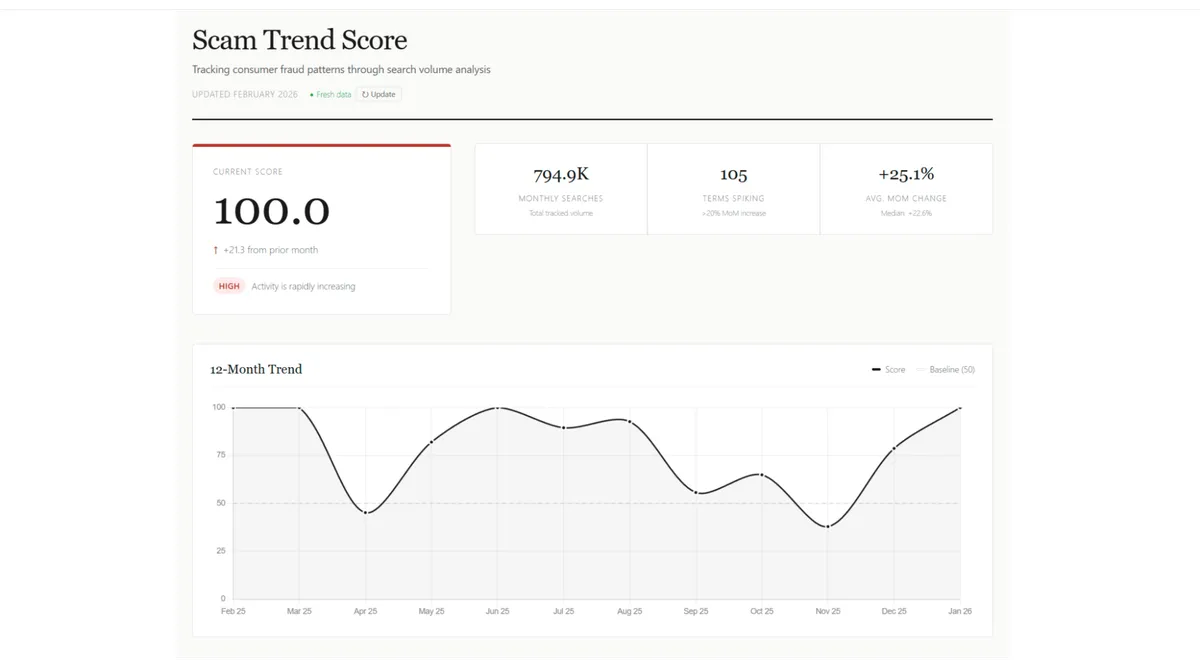
The power of Civoryx lies in its objectivity. It doesn’t rely on “expert” predictions; it uses a rigorous composite metric to produce the Scam Trend Score:
- The Index: A curated list of 150+ fraud-related keywords.
- The Velocity: It tracks month-over-month (MoM) changes in absolute search volume.
- The Normalization: To ensure accuracy, Civoryx uses a dual-layer normalization model. This accounts for seasonal search fluctuations—such as the natural spike in “delivery scams” during the holidays—to ensure the score reflects genuine fraud acceleration rather than predictable calendar cycles.
The result is a composite metric that rises when fraud-related search interest accelerates and falls when it cools. No opinions. No speculation. Just data.
Why Real-Time Data Matters Now
Fraud evolves faster than headlines. In 2026, with the rise of Agentic AI and deepfake-driven employment fraud, scams can go from a single test case to a global epidemic in weeks. Civoryx was built for those who can’t afford to wait for the morning news:
- For Businesses: Compliance and cybersecurity teams can anticipate spikes in specific scam types and proactively warn their customers before the first transaction is ever attempted.
- For Journalists & Researchers: It provides a data-backed starting point for investigations into emerging threats before they peak.
- For Consumers: It serves as an early warning system, allowing everyday users to see what the world is searching for regarding fraud.
As we move through 2026, the digital landscape has reached a critical regulatory tipping point. For businesses operating within the European Union, “compliance” is no longer a back-office checkbox—it is a high-stakes operational requirement with multi-million euro implications.
The convergence of two massive regulatory pillars—eIDAS 2.0 and the EU AI Act—has fundamentally redefined how we verify identity and secure transactions. On one hand, the evolution of eIDAS has mandated a seamless, cross-border infrastructure for electronic signatures and trust services. On the other, the EU AI Act has introduced a rigorous transparency and risk-management framework for the very algorithms that power modern Identity Verification (IDV).
Regulatory Compliance: The European Market and eIDAS 2.0
Compliance in 2026 is a fragmented patchwork. In Europe, the eIDAS regulation (Electronic Identification, Authentication and Trust Services) has evolved to mandate that Member States process electronically signed documents and recognize advanced electronic signatures. This has led to the rise of specialized European providers like Tecalis, which integrates qualified electronic signatures (QES) and time-stamping directly into the KYC flow.
The EU AI Act and E-Signature Platforms
The 2 August 2026 deadline for high-risk AI systems in the EU has significantly impacted IDV providers. Businesses must now ensure that their AI-powered identity verification meets both eIDAS standards and the EU AI Act’s transparency requirements. Failure to classify an AI tool correctly as “high-risk” can result in penalties up to €15 million.
Tecalis positions itself as a 100% compliant platform for this environment, offering:
- Certified Video Identification: Using streaming video and AI to process documents in real-time while maintaining eIDAS compliance.
- European EUDI Wallet Framework: Support for Sovereign Digital Identity (SSI) where users control their data via digital wallets.
- PSD2 and AML6 Readiness: Implementing Strong Customer Authentication (SCA) and meeting the latest AML certifications for banking and fintech.
U.S. Regulatory Scrutiny: FinCEN and the IRS
In the United States, the focus has shifted toward “Beneficial Ownership Information” (BOI) reporting and heightened scrutiny of tax identities. Compliancely and Trulioo have both integrated BOI reporting and expanded KYB intelligence to meet FATF guidelines and FinCEN updates. The “Dynamic KYB” approach is specifically designed to handle the “patchwork of reporting requirements” across the U.S. that vary by state and industry.
Conclusion
Civoryx is free, public, and built on the principle that transparency is a powerful deterrent. In a digital economy, information is the best defense. By moving beyond traditional, delayed indicators and focusing on the real-time velocity of search data, the Global Fraud Index provides the one thing the industry has been missing: foresight.
How Civoryx works:
- Monitor. Civoryx continuously tracks search volume for 150+ fraud-related keywords — spanning phishing, identity theft, crypto scams, romance fraud, and more.
- Measure. It calculates the month-over-month change for each keyword and weights it by its absolute search volume. High-volume keywords that spike carry more signal than niche terms with noise.
- Score. The weighted changes are aggregated into a single composite metric: the Scam Trend Score. A rising score means fraud-related search interest is accelerating globally. A falling score means it’s cooling.
The score is updated regularly and displayed publicly — no account required, no paywall, no gating. By the time a scam type makes the news, it’s already peaked. Civoryx surfaces those shifts early.