Global Fraud Index: Seasonal Patterns in Fraud-Related Search Activity
Fraud attention does not move randomly. It follows rhythms — shaped by financial calendars, tax cycles, consumer behavior, and the evolving tactics of impersonation campaigns. The Civoryx Global Fraud Index provides a structured view of these movements by measuring how fraud-related search activity shifts across the internet in real time.
At the center of the index is the Scam Trend Score, a composite metric designed to capture momentum — not just raw volume — in fraud-related queries. By aggregating month-over-month changes across 150 keywords and weighting them by absolute search volume, the score offers a single, transparent signal of where fraud attention is accelerating or cooling globally.
This article examines how the latest dataset reveals seasonal concentration, channel shifts, and divergence patterns — highlighting how fraud awareness cycles emerge in measurable, repeatable ways.
Why a Seasonal Lens Matters
Fraud evolves quickly, often outpacing traditional reporting cycles. Headlines tend to reflect what has already peaked, while search behavior reveals what is happening now. Seasonal analysis provides a framework for interpreting these shifts by identifying recurring periods where certain fraud types dominate attention.
The Global Fraud Index was built to surface these changes early. By focusing on search velocity — how quickly interest rises or falls — the index captures behavioral signals that precede broader awareness.
This approach is grounded in a clear principle: fraud attention is observable through collective information-seeking behavior. When a scam begins spreading, people search for verification, reporting steps, or explanations. Aggregating these searches provides a measurable proxy for fraud activity awareness.
Methodology: Three Layers, One Signal
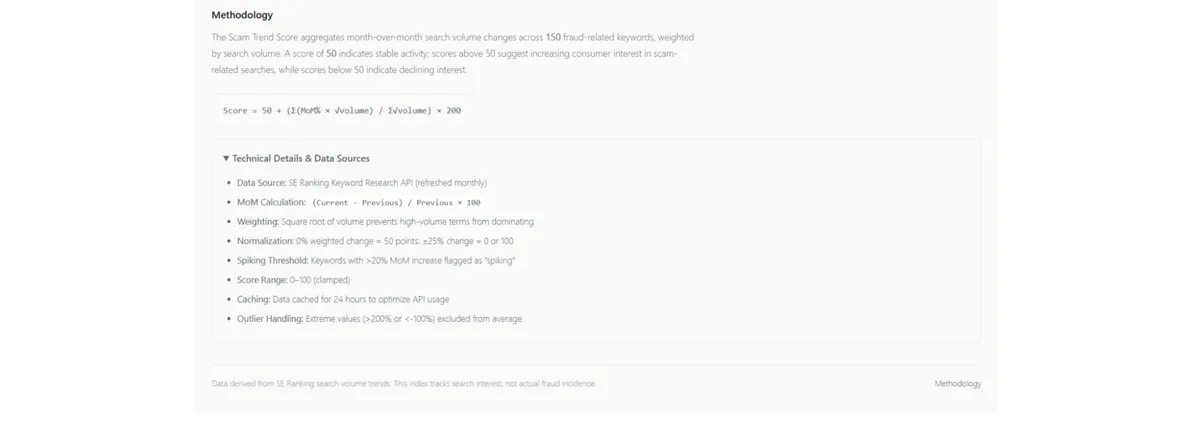
The Scam Trend Score is generated through a structured three-layer process:
- Monitor. Continuous tracking of search volume across a curated set of 150+ fraud-related keywords spanning phishing, identity theft, payment scams, impersonation, and infrastructure fraud.
- Measure. Calculation of month-over-month changes for each keyword, weighted by absolute search volume. High-volume spikes therefore exert more influence on the index than low-volume fluctuations.
- Score. Aggregation of weighted changes into a single composite metric. A rising score indicates accelerating global interest in fraud topics, while a decline indicates cooling attention.
A unique methodological component underpins the seasonal analysis: Civoryx uses a dual-layer normalization model to account for seasonal search fluctuations.
This model adjusts for predictable calendar-driven patterns — such as tax filing periods or holiday shopping cycles — ensuring that the index reflects true anomalies rather than routine seasonal increases. The result is a clearer distinction between expected cyclical behavior and emerging fraud spikes.
Concentration of Signal: A Small Cluster Driving Movement
Analysis of the latest dataset shows that index movement is highly concentrated. A relatively small group of themes accounts for the majority of weighted impact, indicating that fraud attention is currently dominated by a narrow set of narratives.
Top contributors to the score:
- tax fraud — contribution 75.74
- ez pass scams — 57.94
- credit card fraud — 21.36
- coinbase text scam — 12.43
- paypal scam email — 10.53
- toll scam text — 9.51
- geek squad scam — 7.83
- dmv scam text — 5.20
- visa fraud — 3.57
- paypal email scam — 2.20
This distribution shows that seasonal financial fraud and impersonation campaigns are exerting the strongest influence on global fraud attention. The dominance of tax-related queries aligns with predictable financial cycles, while the presence of payment and impersonation scams reflects ongoing exploitation of transactional trust.
Fastest-Growing Scam Themes
Beyond overall contribution, the velocity of growth highlights where attention is accelerating most rapidly. Several infrastructure- and payment-related scams recorded exceptionally high month-over-month increases:
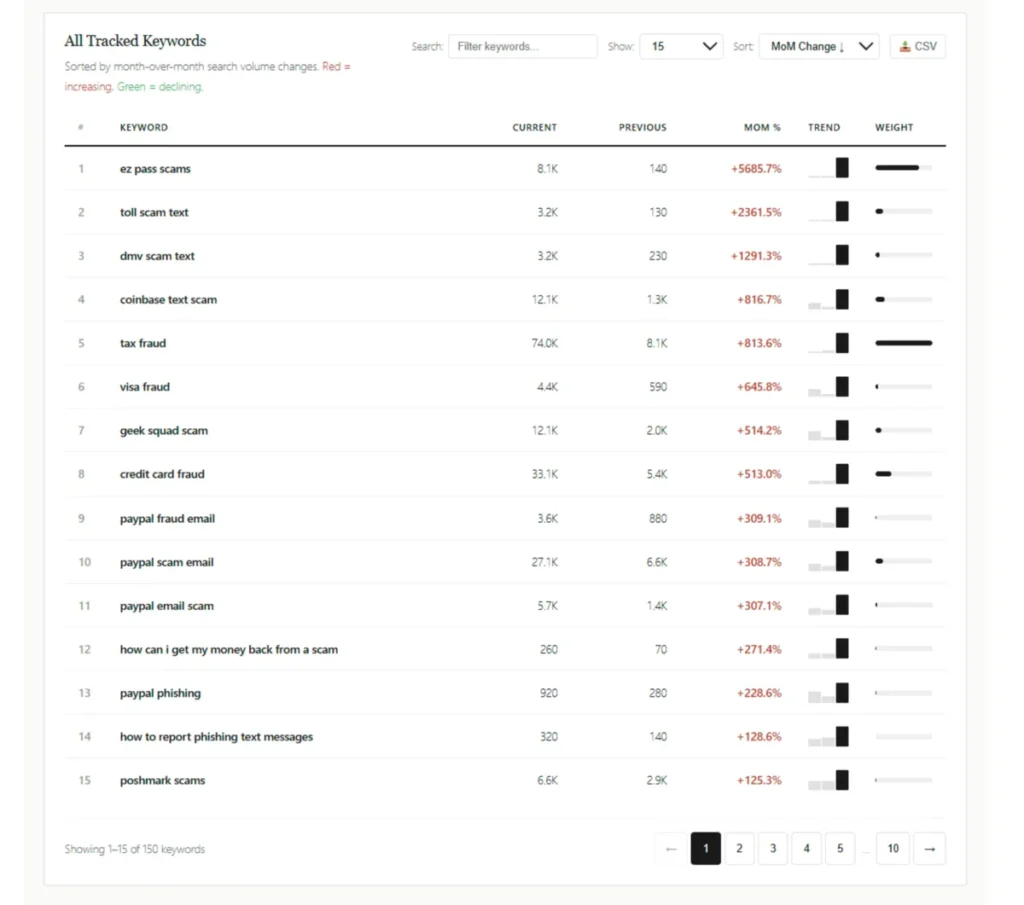
- ez pass scams — +5,685%
- toll scam text — +2,361%
- dmv scam text — +1,291%
- coinbase text scam — +817%
- tax fraud — +814%
- visa fraud — +646%
- geek squad scam — +514%
- credit card fraud — +513%
Together, these spikes indicate a pronounced shift toward SMS-driven impersonation and payment fraud. The pattern suggests that delivery channels — not just scam narratives — play a significant role in shaping attention cycles.
Because the index weights changes by search volume, rapid growth in widely searched topics amplifies their influence on the overall score, reinforcing the concentration effect observed in the dataset.
Declining Attention: The Other Side of the Cycle
While several specific scam types surged, broader or more generic awareness queries declined:
- is this a scam — -55%
- gift card scam — -46%
- mcafee scam — -45%
- brushing scam — -19%
- phishing — -18%
This divergence — rising attention for specific threats alongside declining generic queries — often characterizes a narrative-driven fraud cycle. When a limited set of high-visibility scams dominates public discourse, users search directly for those threats rather than for general guidance.
From a measurement perspective, this dynamic illustrates how attention consolidates around particular fraud stories, increasing signal clarity within the index.
Category Structure of the Signal
Grouping keywords by intent provides additional insight into how fraud attention is distributed:
- Tax-related fraud: ≈75.7 contribution — the single largest driver
- Payments & financial scams: ~56 contribution across card and wallet fraud
- Messaging vectors (SMS/email/calls): ~15.6 contribution, reflecting delivery-channel risk
- Phishing (generic): ~4 contribution, relatively stable
- Reporting/prevention queries: ~1.7 contribution, lower growth
The February profile underscores the index’s core strength: rapid visibility into where attention is concentrating at a given moment. Tax-related searches dominate, consistent with seasonal financial timelines, while payment and messaging-based scams form the next largest cluster.
Interpreting Seasonal Patterns
Seasonality in fraud attention typically emerges from the intersection of three factors:
- Financial deadlines and obligations — such as tax filing periods, billing cycles, or benefit disbursements.
- Consumer behavior peaks — including travel seasons or shopping periods that increase transaction volume.
- Operational timing by fraud campaigns — which often align with moments of heightened urgency or confusion.
The dual-layer normalization model ensures that these predictable patterns are accounted for, allowing the index to highlight deviations — the moments when attention rises faster than seasonal baselines would predict.
Channel Shift Toward Messaging-Based Fraud
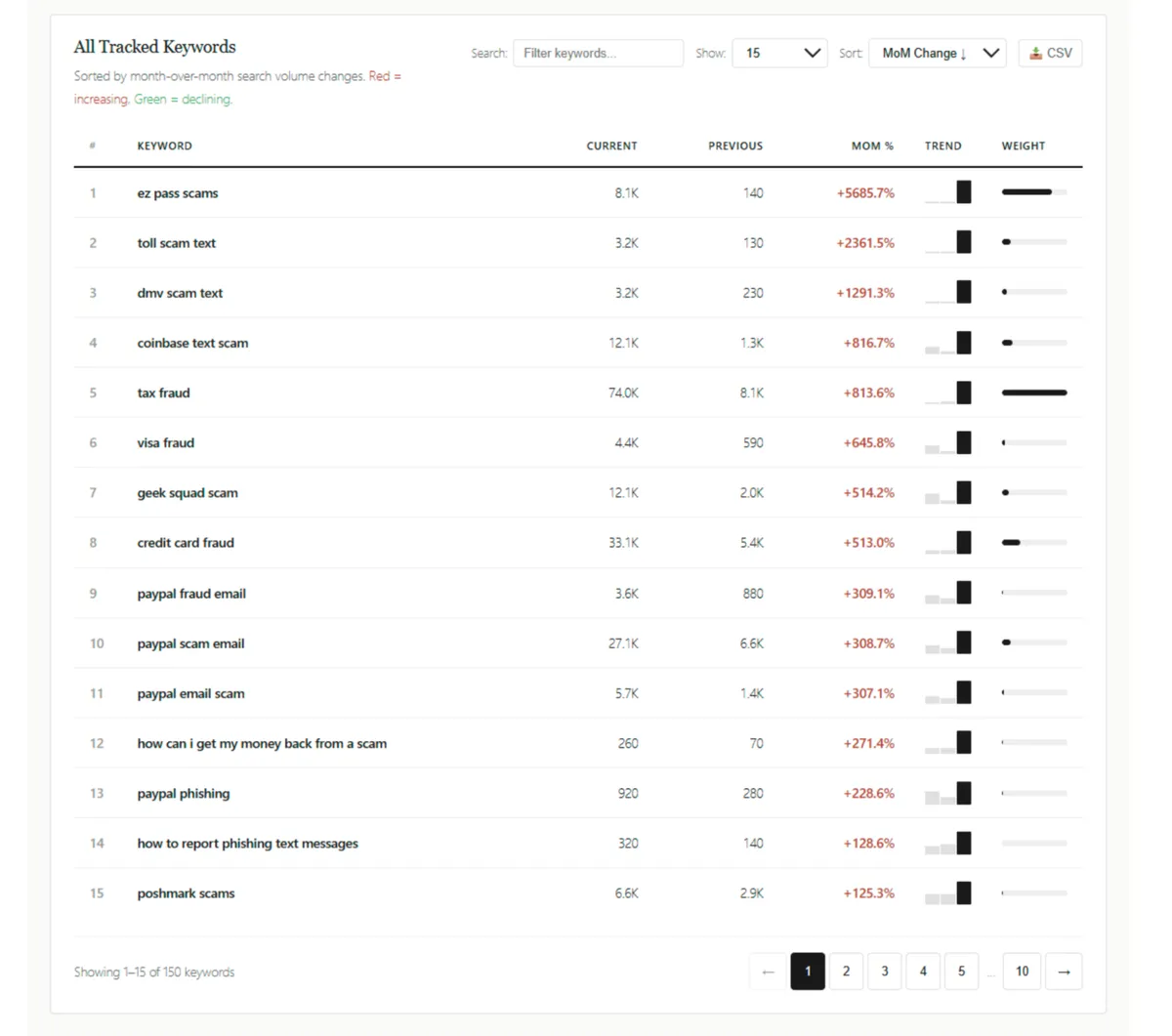
The strong growth in toll, DMV, and payment text scams illustrates how fraud attention is increasingly tied to communication channels.
Search spikes tied to SMS-based impersonation campaigns suggest that users are encountering messages prompting immediate verification or payment actions. When such campaigns expand, search behavior reflects a surge in verification queries, which in turn elevates the index.
This channel-centric perspective complements category analysis by showing not only what scams are prominent but also how they are delivered.
Transparency and Public Access
The Global Fraud Index is designed as a public resource. The Scam Trend Score and underlying trend data are available without accounts, subscriptions, or paid tiers.
This open model supports a broad range of users — including researchers, compliance teams, journalists, and consumers — by providing a shared reference point for tracking fraud attention.
The decision to keep the index free reflects a foundational premise: fraud awareness benefits from transparency, and data visibility improves collective understanding of risk patterns.
What the February Profile Shows
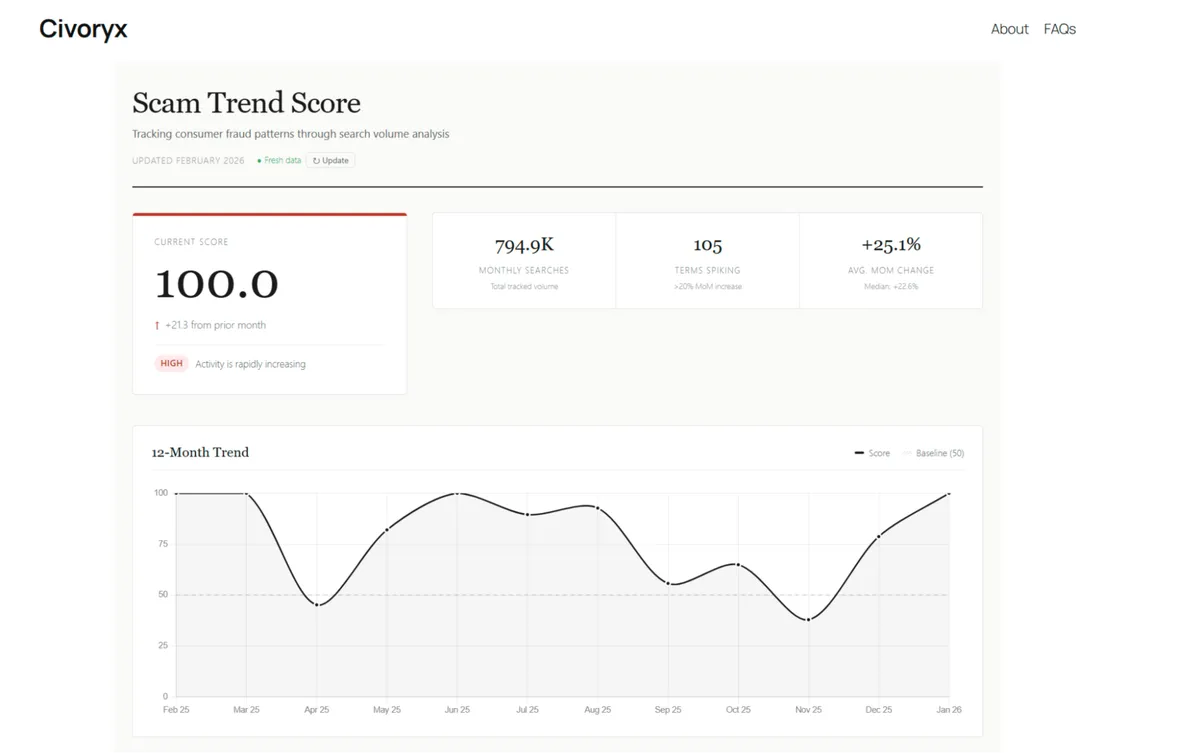
The latest dataset highlights several defining characteristics of the current fraud attention cycle:
- High concentration — a small cluster of themes drives most movement.
- Seasonal dominance — tax-related searches lead the index.
- Channel-specific growth — SMS-based impersonation shows rapid acceleration.
- Narrative divergence — specific scams rise while generic awareness declines.
Together, these elements demonstrate how fraud attention forms identifiable patterns rather than diffuse, uniform growth.
The Role of Composite Metrics
A key advantage of the Scam Trend Score lies in its ability to synthesize complex datasets into a single interpretable signal. Individual keyword spikes may be noisy or localized, but aggregation reveals broader trends.
Because the metric reflects both magnitude and velocity, it captures the momentum of attention — showing not only which scams are widely searched but also which are gaining traction fastest.
Composite metrics therefore provide a macro-level view while still allowing deeper analysis of underlying components.
Looking at Fraud Through Search Behavior
Search data offers a unique perspective on fraud because it captures real-time reactions. Unlike incident reports, which can lag, search queries appear at the moment users seek clarification or help.
By structuring these queries into a consistent index, the Global Fraud Index transforms dispersed behavioral signals into a coherent timeline of attention shifts. Seasonal patterns become visible, concentration effects can be measured, and emerging narratives can be identified early.
Conclusion
Seasonal patterns in fraud-related search activity reveal that global attention cycles are neither random nor evenly distributed. Instead, they are shaped by predictable financial timelines, evolving delivery channels, and the prominence of specific narratives.
The Civoryx Global Fraud Index quantifies these dynamics through the Scam Trend Score, a composite metric built on continuous monitoring, weighted change measurement, and aggregation. Its dual-layer normalization model ensures that seasonal fluctuations are accounted for, allowing genuine anomalies to stand out.
Current data shows a concentrated signal dominated by tax-related fraud and payment impersonation, rapid growth in SMS-driven scams, and declining interest in generic awareness queries. Together, these patterns illustrate how fraud attention clusters around specific themes at particular times of the year.
By translating search behavior into a transparent, public metric, the index provides a real-time lens into how the world’s focus on fraud evolves — revealing seasonal rhythms and shifts as they unfold.