Global Fraud Index: How to Read and Interpret the Scam Trend Score
In the rapidly shifting landscape of digital deception, timing is everything. By the time a new fraudulent scheme reaches the evening news or a government consumer alert, the peak of the attack has often already passed. Criminals operate with an agility that traditional reporting mechanisms struggle to match. This lag creates a “blind spot” where businesses, researchers, and consumers are left reacting to yesterday’s threats.
Enter Civoryx, the Global Fraud Index. Civoryx was engineered to eliminate this lag by monitoring the most honest reflection of public concern: search engine behavior. When people encounter a suspicious text, a strange email, or an unexplained charge, they turn to the internet. Civoryx aggregates these digital breadcrumbs into a single, transparent signal: the Scam Trend Score.
What is the Scam Trend Score?
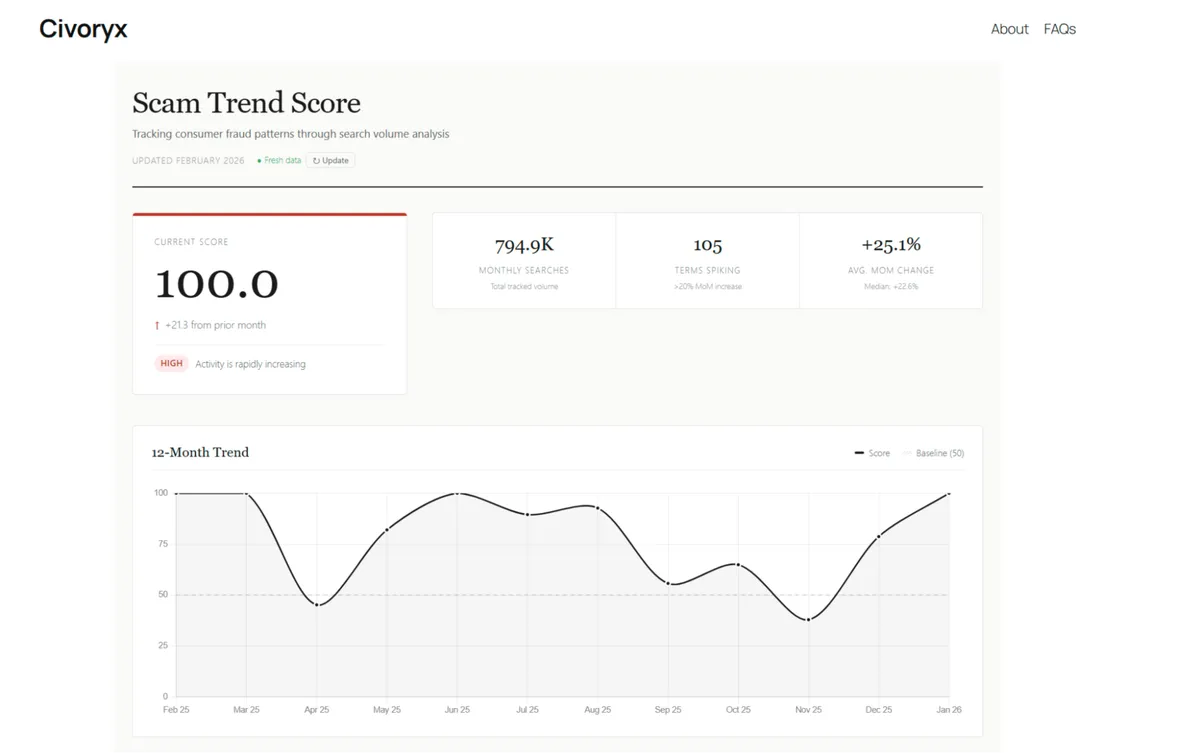
The Scam Trend Score is a composite metric designed to track how fraud attention shifts across the internet in real-time. Unlike qualitative reports that rely on subjective expert opinions or delayed victimization surveys, Civoryx relies exclusively on objective data.
The index monitors a curated list of 150 fraud-related keywords. By tracking the month-over-month (MoM) velocity of these terms and weighting them by their absolute search volume, the score provides a macro-view of the global fraud climate. When the score rises, fraud-related search interest is accelerating; when it falls, the “heat” of the fraud landscape is cooling.
The Civoryx Methodology: Three Layers, One Score
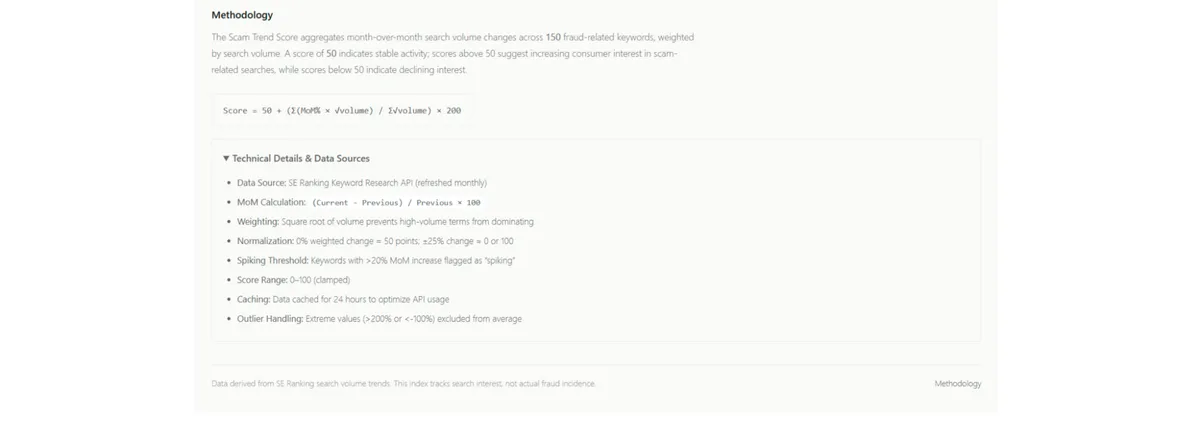
To understand the score, one must understand the engine behind it. Civoryx operates on a three-tier processing model:
- Monitor: The system continuously tracks search volume for 150 keywords spanning categories like phishing, identity theft, crypto scams, romance fraud, and impersonation.
- Measure: The index calculates the MoM change for each keyword. Crucially, it applies a weighting system. High-volume keywords that see a spike carry significantly more “signal” than niche terms that may just be experiencing statistical noise.
- Score: These weighted changes are aggregated into the final Scam Trend Score, offering a single, easy-to-digest number that represents the current acceleration or deceleration of fraud interest globally.
The Civoryx Unique Edge: Dual-Layer Normalization
A common pitfall in search-based data is seasonality. For example, “tax fraud” searches naturally peak in the spring, while “package delivery scams” surge during the holiday shopping season. To prevent these predictable cycles from distorting the true “threat” level, Civoryx uses a dual-layer normalization model to account for seasonal search fluctuations.
This model compares current spikes not just against the previous month, but against historical norms for that specific timeframe. This ensures that a rise in the Scam Trend Score represents a genuine shift in criminal activity or public vulnerability, rather than a recurring calendar event.
Interpreting the Current Data: A Concentrated Signal
Analysis of the latest keyword dataset reveals a highly concentrated signal. The movement of the index isn’t being driven by a broad, even rise across all categories; instead, a small cluster of themes is exerting a massive influence on the global score.
Top Contributors to the Score (Weighted Impact)
The following terms have the largest weighted impact on the current index:
| Keyword | Weighted Contribution |
| Tax Fraud | 75.74 |
| EZ Pass Scams | 57.94 |
| Credit Card Fraud | 21.36 |
| Coinbase Text Scam | 12.43 |
| PayPal Scam Email | 10.53 |
| Toll Scam Text | 9.51 |
| Geek Squad Scam | 7.83 |
| DMV Scam Text | 5.20 |
| Visa Fraud | 3.57 |
| PayPal Email Scam | 2.20 |
From a compliance and cybersecurity perspective, this concentration indicates that seasonal financial fraud and impersonation campaigns are currently the primary drivers of global fraud attention.
The “Velocity” Factor: Fastest-Growing Scam Themes
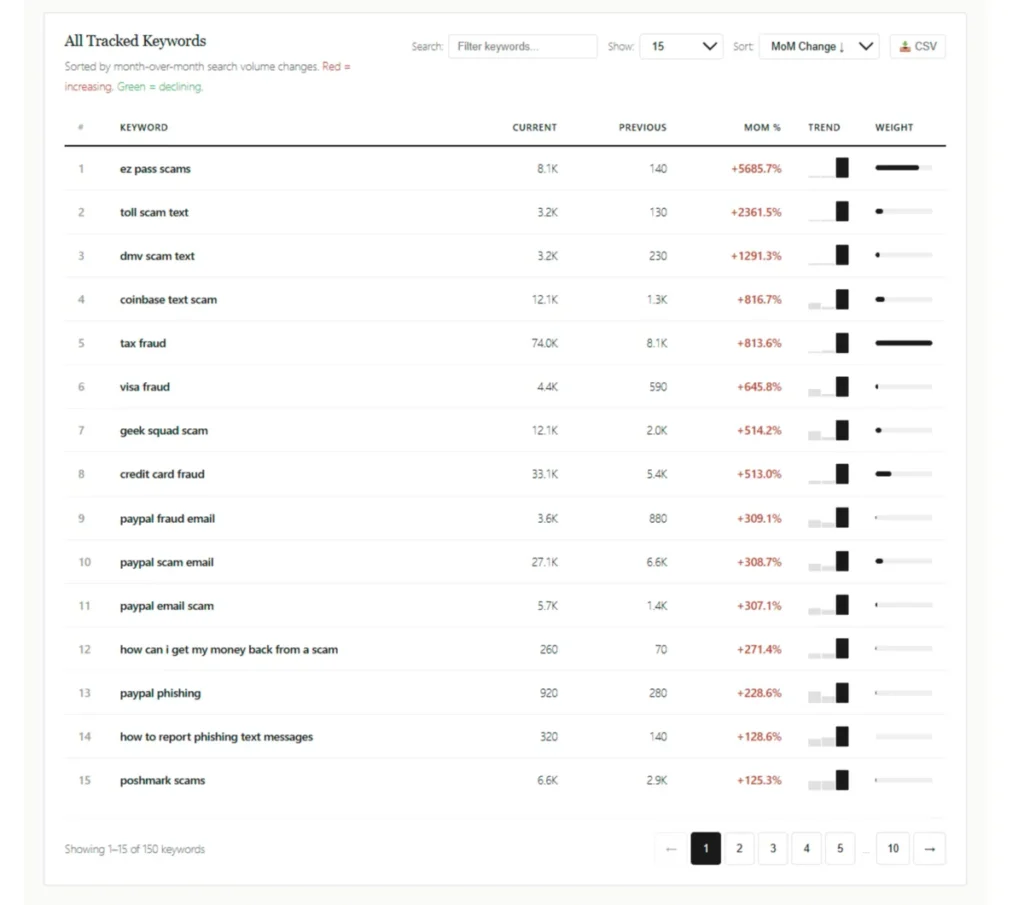
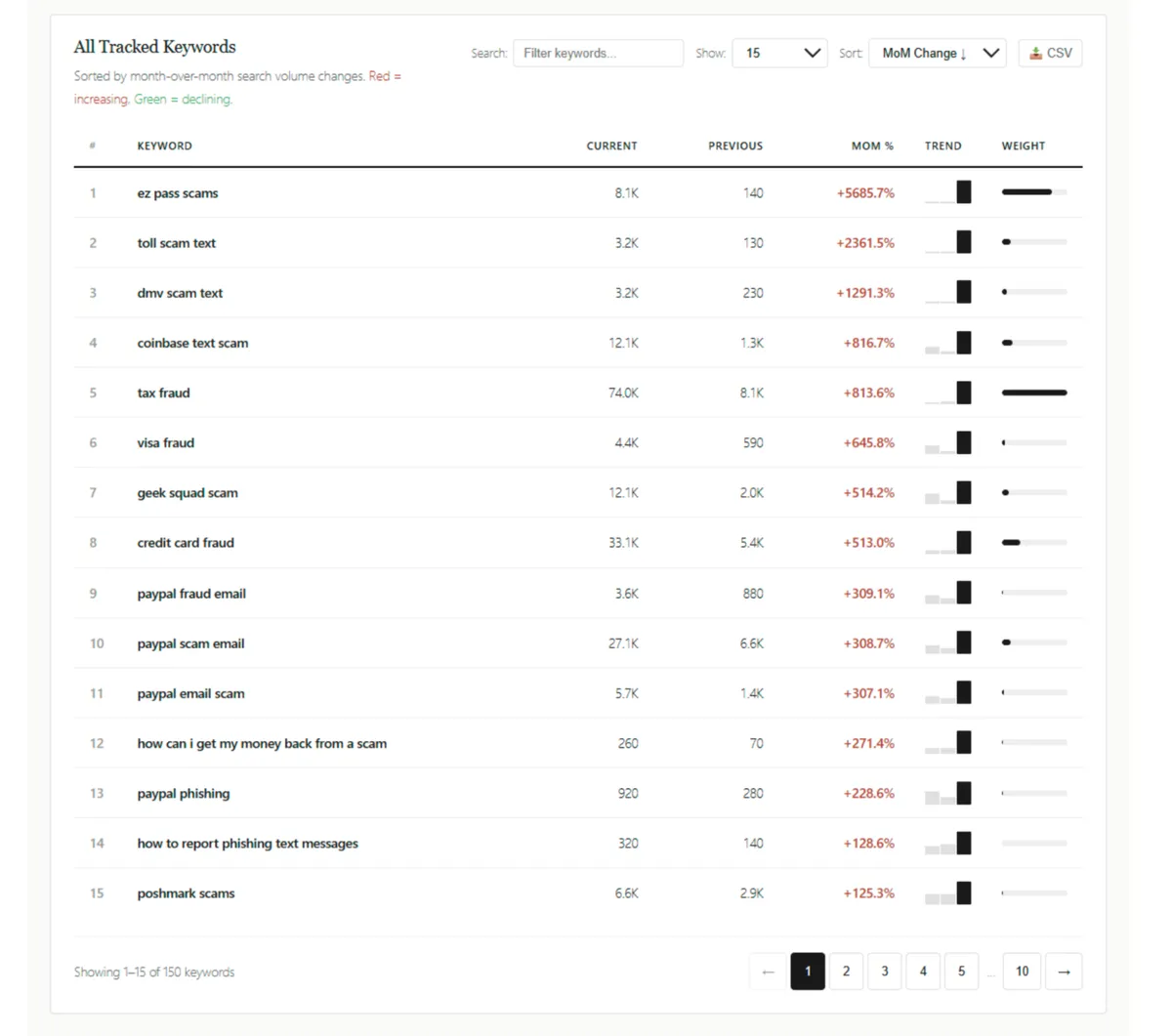
While the weighted impact shows what is dominating the index, the MoM growth percentages show what is exploding. The Civoryx dataset currently shows unusually sharp growth in infrastructure and payment-related scams, signaling a tactical shift by threat actors.
- EZ Pass Scams: +5,685%
- Toll Scam Text: +2,361%
- DMV Scam Text: +1,291%
- Coinbase Text Scam: +817%
- Tax Fraud: +814%
- Visa Fraud: +646%
- Geek Squad Scam: +514%
- Credit Card Fraud: +513%
The astronomical rise in “EZ Pass” and “Toll” related scams points to a massive channel shift toward SMS-driven impersonation (smishing). These scams exploit “low-friction” fears—the idea that a small, unpaid toll might result in a large fine—to trick users into clicking malicious links.
The Divergence: Why Generic Searches are Falling
Interestingly, not all categories are in the green. Civoryx has tracked a significant decline in generic or broad awareness queries:
- “Is this a scam”: -55%
- Gift card scam: -46%
- McAfee scam: -45%
- Brushing scam: -19%
- Phishing: -18%
This divergence—where specific scam types rise while generic awareness queries fall—is a critical signal. It often indicates a narrative-driven fraud cycle. In this phase, the public isn’t searching for general “phishing” advice; they are reacting to specific, highly convincing narratives like a “DMV text” or a “Coinbase alert.” This suggests that attackers have moved away from broad “spray and pray” tactics toward more focused, high-conversion impersonation themes.
The Infrastructure of the Index: The 150 Keywords
To maintain a comprehensive view, Civoryx categorizes its 150 keywords into distinct intent groups. This structure allows users to see not just that fraud is rising, but how it is being delivered.
1. Phishing & Digital Communication
These terms track entry methods—spoofed emails and malicious links.
Key terms: phishing attack, report phishing email, what to do if I clicked on a phishing link.
2. P2P Payment & Banking Scams
Monitoring the platforms most frequently targeted for instant fund transfers.
Key terms: Zelle scams, Venmo scam, Cash App scam, PayPal fraud, credit card fraud.
3. Brand & Service Impersonation
Tracking the misuse of trusted names to lower victim defenses.
Key terms: Amazon scam, Geek Squad scam, McAfee scam, EZ Pass scams.
4. Identity & Government Fraud
Traditional, high-impact crimes involving official documentation.
Key terms: Identity fraud, tax fraud, Medicare fraud, welfare fraud.
5. Emerging Threats: Crypto & Modern Scams
Tracking the evolution of technology-driven crime.
Key terms: Crypto scam, Coinbase text scam, brushing scam, fraud score.
6. Recovery & Reporting (“Victimization Signals”)
When volume here rises, it indicates a high rate of successful scams where victims are now seeking help.
Key terms: How to get your money back from a scam, report a scam, what to do if you’ve been scammed.
Category Structure of the Keywords Tracked by Civoryx
Grouping the keywords by intent illustrates exactly how the index composition breaks down, highlighting the dominant forces in the current month:
- Tax-related fraud: The single largest driver (≈75.7 contribution).
- Payments & financial scams: ~56 contribution across card and digital wallet fraud.
- Messaging vectors (SMS/email/calls): ~15.6 contribution, heavily reflecting delivery-channel risk.
- Phishing (generic): ~4 contribution, remaining relatively stable.
- Reporting/prevention queries: ~1.7 contribution, showing lower growth compared to active victimization signals.
This profile underscores the main strength of the Scam Trend Score: it provides rapid, undeniable visibility into exactly where fraud attention is concentrating right now.
Conclusion: Who is Civoryx For?
Civoryx was built as a public utility. Because fraud evolves faster than the traditional news cycle, the index provides a real-time lens for various stakeholders:
- Compliance Teams: Use the data to reassess customer-communication controls and alerting thresholds. If “Visa Fraud” searches are spiking by 646%, it may be time to update customer warnings.
- Cybersecurity Professionals: Identify emerging “smishing” (SMS phishing) narratives before they saturate the network.
- Journalists & Researchers: Access raw, unbiased data on what fraud themes are actually impacting the public.
- Everyday Users: Check the index to see if the “weird text” you just received is part of a global trend.
The most unique aspect of Civoryx is its accessibility. Civoryx is free. Fully. Permanently. There are no paid tiers, no premium plans, and no gated features.
| Feature | Public Access |
| Scam Trend Score | Included |
| 150+ Keyword Index | Included |
| MoM Trend Data | Included |
| Account Required | No |
| Cost | $0 |
The creators of Civoryx believe that fraud transparency shouldn’t have a price tag. Because the problem of digital fraud is universal, the data used to fight it must be open.
Frequently Asked Questions (FAQs)
How does the Scam Trend Score differ from traditional fraud reports?
Traditional fraud reports, such as those from government agencies or financial institutions, typically rely on reported cases and victimization surveys. These reports often have a “lag time” of months or even a year. In contrast, the Scam Trend Score tracks real-time search intent. By monitoring what people are searching for the moment they encounter a suspicious message, Civoryx identifies emerging threats weeks before they appear in official statistics.
Why is “Tax Fraud” such a high contributor compared to other scams?
Tax fraud consistently ranks as a top contributor due to its high absolute search volume and its significant weighted impact on the index. Because tax-related scams involve high stakes—such as identity theft or the loss of a refund—users are much more likely to search for verification. Civoryx uses its dual-layer normalization model to ensure that while we acknowledge this seasonal surge, the score still accurately reflects whether this year’s “tax season” is more volatile than previous years.
If the Scam Trend Score is falling, does that mean I am safer?
Not necessarily. A falling score indicates that aggregate search interest in the 150+ tracked fraud keywords is cooling or stabilizing globally. However, as the latest data shows, generic searches (like “is this a scam”) can fall even while specific, highly targeted scams (like “EZ Pass scams”) are exploding by over 5,000%. A falling score may simply mean the fraud landscape is transitioning from broad, high-volume campaigns to more concentrated, narrative-driven attacks.